Seahorse Facts
"Seahorses are fish, even though they look very different from most fish."
Lined seahorses are tiny fish with horse-like heads, curly tails, and one of the ocean's most unusual family roles—males carry the eggs.
Loading page content

"Seahorses are fish, even though they look very different from most fish."
Lined seahorses are tiny fish with horse-like heads, curly tails, and one of the ocean's most unusual family roles—males carry the eggs.
Hippocampus erectusSyngnathiformesSyngnathidae
Explore lined seahorse photos organized for learning and classroom observation.
Click any photo to view it larger. 8 images available.
Core article
Habitat, diet, behavior, and more — everything on one page.
The lined seahorse (Hippocampus erectus) is a master of aquatic camouflage and one of the ocean's most morphologically unique teleost (bony) fishes. Hovering vertically among the swaying blades of coastal seagrass meadows and the complex structures of coral reefs, this diminutive predator challenges the traditional notion of what a fish looks like. Most famously, the seahorse completely upends traditional reproductive biology, presenting a rare system where the male undergoes pregnancy and childbirth.
Classified within the kingdom Animalia and the phylum Chordata, the lined seahorse is a true bony fish (class Actinopterygii). It belongs to the order Syngnathiformes, a highly specialized group characterized by fused jaws that form a tubular snout. Within this order, it sits in the family Syngnathidae, sharing its lineage with pipefish and seadragons.
The genus name Hippocampus is derived from ancient Greek, translating literally to "horse sea-monster," perfectly capturing its equine head and serpentine tail. The specific epithet erectus refers to its distinctive vertical posture. Evolutionarily, syngnathids likely diverged from a pipefish-like ancestor approximately 20 to 25 million years ago. The development of a vertical posture and a prehensile tail allowed them to expertly navigate and anchor themselves in the expanding, complex three-dimensional habitats of seagrass beds that proliferated during the Miocene epoch.
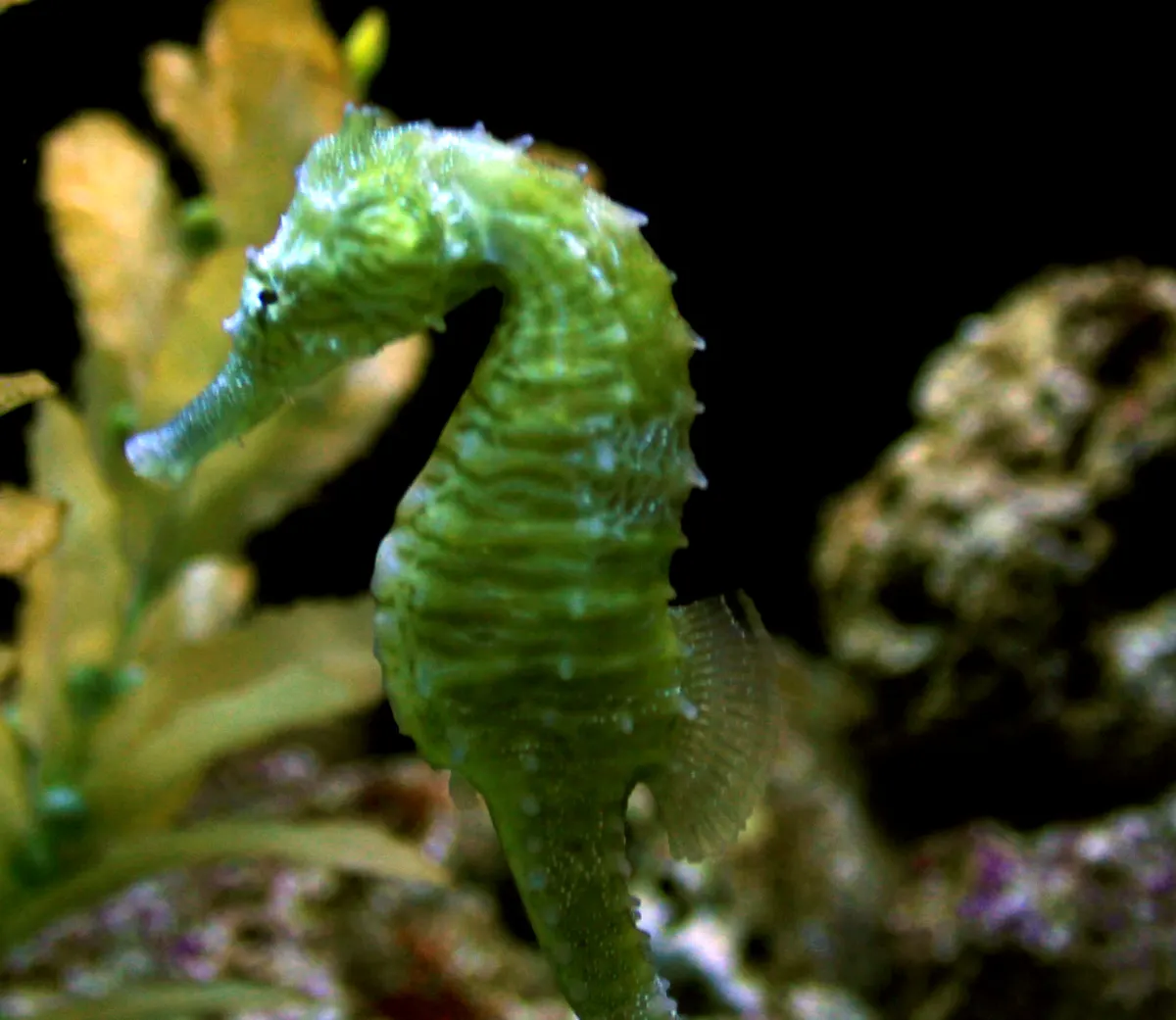
A mature lined seahorse typically measures a diminutive 4 to 6 inches in length and weighs a fraction of an ounce (0.2 to 0.5 ounces). Unlike most fish, they lack scales. Instead, their bodies are encased in a series of rigid, interlocking bony plates covered by a thin layer of skin, functioning as an external exoskeleton that provides excellent protection against small predators.
Their anatomical adaptations are highly derived. They possess a long, tubular snout terminating in a small, toothless mouth. Their eyes are highly modified, capable of moving independently of one another—much like a chameleon's—allowing them to scan a 360-degree field of vision for microscopic prey without moving their heads and breaking their camouflage.
Swimming is not their forte. They lack pelvic and caudal (tail) fins entirely. To maneuver, they rely on a rapidly fluttering dorsal fin (beating up to 35-70 times per second) for forward propulsion, and small pectoral fins located behind their eyes for steering and stability. Because they are weak swimmers, they have evolved a specialized prehensile tail, capable of tightly gripping seagrass blades, mangrove roots, or gorgonian corals to avoid being swept away by strong oceanic currents.

The lined seahorse is distributed extensively along the western Atlantic coast. Their geographic range stretches from the cold coastal waters of Nova Scotia, Canada, southward along the United States eastern seaboard, into the Gulf of Mexico, the Bahamas, and down to the tropical coasts of Brazil.
They are heavily associated with structured, shallow-water coastal habitats. They are most frequently found clinging to vegetation in lush seagrass meadows, within the tangled submerged roots of mangrove forests, or among the branching structures of shallow coral and sponge reefs. These complex biomes offer crucial holdfasts for their tails and harbor high densities of the micro-crustaceans they require for survival.

As ambush predators, lined seahorses rely entirely on stealth. Lacking a stomach for long-term food storage and possessing a highly inefficient, rapid digestive tract, a seahorse must feed almost continuously to survive, consuming up to 3,000 tiny crustaceans in a single day.
Their diet consists primarily of minuscule pelagic and benthic invertebrates, including copepods, tiny mysid shrimp, amphipods, and crustacean larvae. To hunt, the seahorse anchors itself to a blade of seagrass and utilizes its camouflage to blend seamlessly into the background. When a prey item drifts within a few millimeters of its snout, the seahorse executes a devastatingly fast strike. By rapidly expanding its buccal cavity (mouth), it creates a powerful localized vacuum, instantly sucking the prey into its tubular snout whole—a biomechanical mechanism known as pivot feeding. The strike is so rapid (often completed in a few milliseconds) that the prey has no time to evade.

Lined seahorses exhibit remarkable social behaviors, most notably their strong propensity for monogamous pair bonding. While many fish are broadcast spawners with zero social structure, a male and female lined seahorse will often pair up for an entire breeding season, and sometimes across multiple seasons.
To reinforce this bond, the pair engages in an intricate daily greeting ritual. Every morning, the female approaches the male's territory. The two fish undergo dramatic color changes—flashing vibrant yellows and oranges—and engage in a synchronized "dance." They entwine their prehensile tails and promenade together through the seagrass, sometimes pirouetting in the water column. This daily reinforcement ensures their reproductive cycles remain perfectly synchronized.
Aside from their reproductive rituals, they rely heavily on cryptic coloration. Lined seahorses can slowly alter their skin pigmentation to match their surroundings, and many develop fleshy appendages called cirri that break up their silhouette, making them look identical to algae-covered seagrass.

The reproductive strategy of the seahorse is one of the most extreme examples of paternal care in the animal kingdom. Male seahorses possess a highly vascularized brooding structure on their ventral side, known as a brood pouch, functionally similar to a mammalian uterus.
During the climax of their courtship dance, the female extends a specialized reproductive organ called an ovipositor and deposits dozens to hundreds of unfertilized eggs directly into the male's open brood pouch. The male instantly fertilizes the eggs as they enter. The female then departs, her reproductive investment complete.
The male assumes full responsibility for gestation, which lasts approximately two to four weeks depending on water temperature. Inside the pouch, the male provides the developing embryos with oxygen, osmotic regulation, and lipid-rich nutrients via a capillary network. When gestation is complete, the male undergoes muscular contractions—effectively going into labor—and forcefully expels fully formed, miniature seahorses (called fry) into the water column. The fry are entirely independent immediately upon birth and must fend for themselves. Due to immense predation, less than 1% of fry typically survive to adulthood. The lifespan of a lined seahorse in the wild is relatively brief, ranging from 1 to 5 years.
(Population and conservation trend data sourced from the IUCN Red List of Threatened Species)
The lined seahorse is currently listed as Vulnerable on the IUCN Red List. Their population trend is decreasing, primarily due to intense anthropogenic pressures on their coastal habitats.
The greatest threat to Hippocampus erectus is the widespread destruction and degradation of essential coastal habitats, particularly the dredging and pollution of seagrass meadows and mangrove estuaries. Because they are poor swimmers with small home ranges, they cannot simply migrate away when their localized habitat is destroyed.
Furthermore, they face immense pressure from the global wildlife trade. Millions of seahorses are harvested annually as incidental bycatch in shrimp trawls. Once caught, they are frequently sold into the traditional medicine trade, dried and sold as souvenirs, or captured live for the commercial marine aquarium trade, though they are notoriously difficult to keep alive in captivity due to their demanding dietary requirements.
Seahorses are fish, even though they look very different from most fish.
Male seahorses carry eggs in a brood pouch until they hatch.
A seahorse can move each eye separately.
They have no teeth and suck food through a long snout.
Their curled tails can grip seagrass and coral.
Seahorses must eat constantly because they have no stomach.
Select a question to reveal the answer.
A seahorse is a small fish with a horse-like head, a curled tail, and a body covered in bony plates.
Yes. Seahorses are fish with gills and fins, even though they swim upright and look unusual.
Lined seahorses live in coastal Atlantic waters from Nova Scotia to Brazil, often near seagrass and reefs.
Seahorses eat tiny shrimp, plankton, and other small animals they suck in through their snout.
Females place eggs in the male's brood pouch, where he cares for them until the babies hatch.
A baby seahorse is called a fry. Fry are very tiny when they leave the pouch.
Lined seahorses are listed as Vulnerable because of habitat loss, pollution, and collection for aquariums.