Parrot Facts
"Scarlet macaws can live more than 50 years in the wild."
Scarlet macaws are huge, rainbow-colored parrots of tropical rainforests. They fly over the canopy in pairs, crack hard nuts with strong beaks, and are...
Loading page content

"Scarlet macaws can live more than 50 years in the wild."
Scarlet macaws are huge, rainbow-colored parrots of tropical rainforests. They fly over the canopy in pairs, crack hard nuts with strong beaks, and are...
Explore scarlet macaw photos organized for learning and classroom observation.
Click any photo to view it larger. 8 images available.
Core article
Habitat, diet, behavior, and more — everything on one page.
The scarlet macaw (Ara macao) is arguably the most visually spectacular and instantly recognizable parrot on the planet. A massive, vibrantly colored resident of the Neotropical rainforests, this iconic avian species is a masterpiece of evolutionary design, sporting brilliant red, yellow, and blue plumage. Flying high above the unbroken forest canopy in deeply bonded pairs, the scarlet macaw utilizes its formidable, hooked beak to crack the hardest nuts the jungle has to offer. Beyond their striking appearance, these large parrots are highly intelligent, deeply social animals that play a crucial ecological role as seed predators and dispersers within the complex ecosystem of the Amazon basin and Central American rainforests.
Classified within the kingdom Animalia, phylum Chordata, and class Aves, the scarlet macaw belongs to the order Psittaciformes, which encompasses all true parrots, cockatoos, and New Zealand parrots. Within the family Psittacidae, it is placed in the genus Ara, a group containing the large, long-tailed macaws endemic to the Neotropics. Its scientific designation is Ara macao.
The evolutionary history of the Psittaciformes order is characterized by the development of extreme cranial modifications and specialized pedal anatomy, traits heavily selected for exploiting tough, highly protected botanical food sources in complex arboreal environments. The Ara genus diverged to fill the ecological niche of massive, canopy-dwelling frugivores, utilizing extreme bite force to access nutrient-dense kernels completely unavailable to smaller frugivorous birds or monkeys.
The scarlet macaw is a giant among parrots, measuring a staggering 32 to 36 inches in length from the top of its head to the tip of its spectacularly elongated tail feathers, which can make up more than half of its total length. Despite their massive appearance, their avian skeleton is highly pneumatized (hollow), keeping their weight relatively light at 2 to 2.5 pounds.
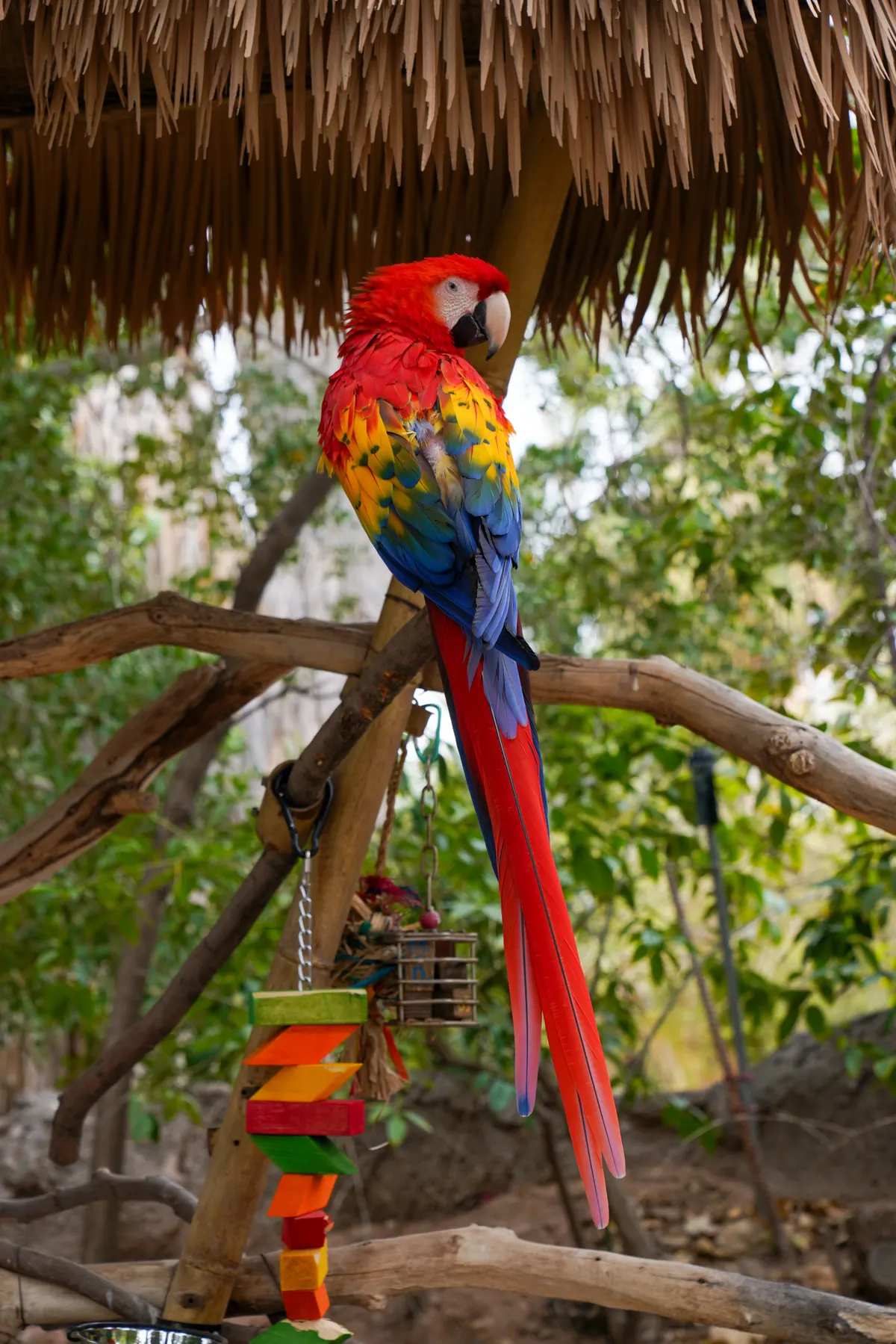
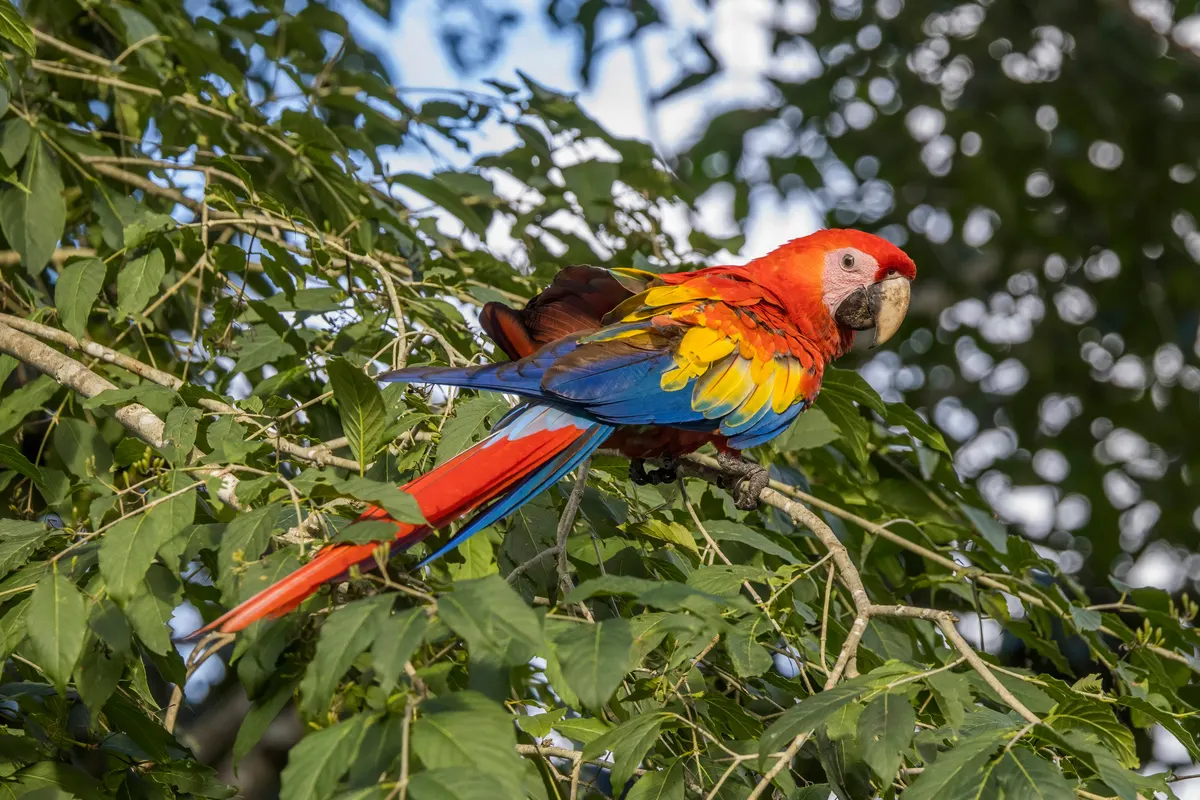
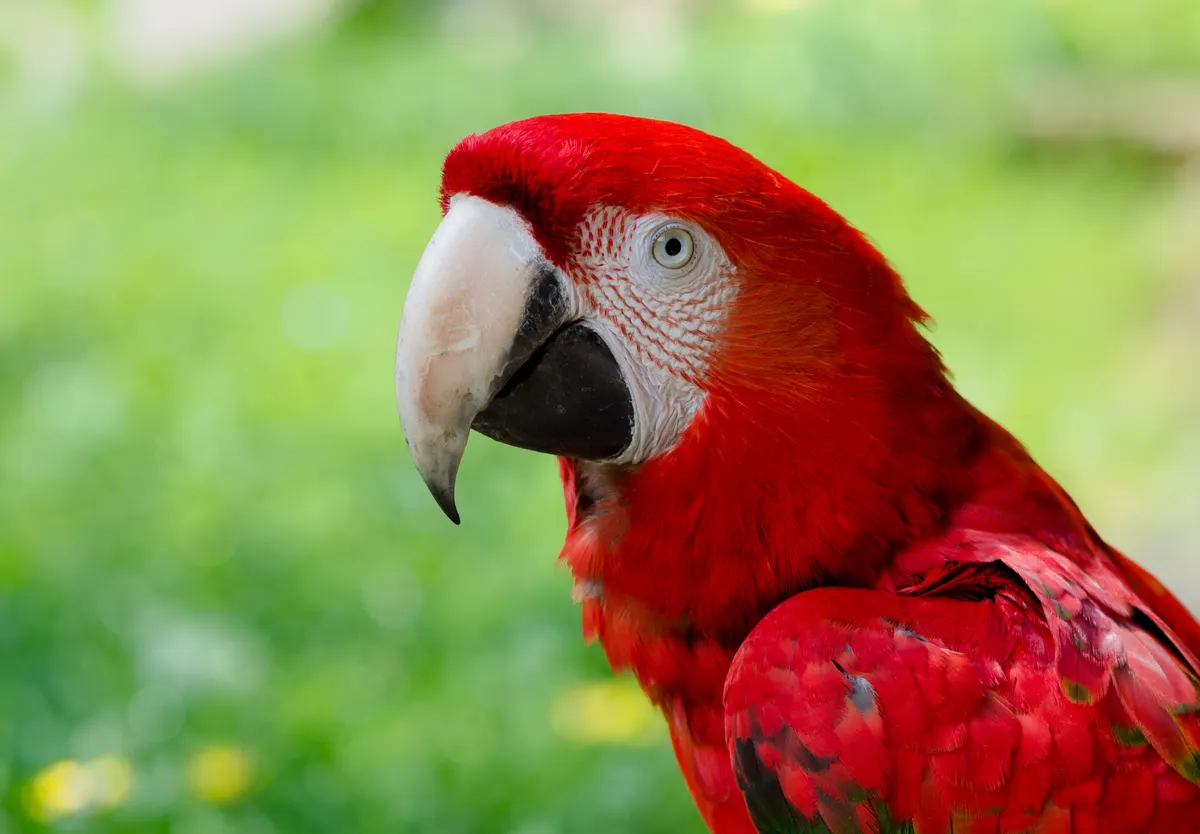
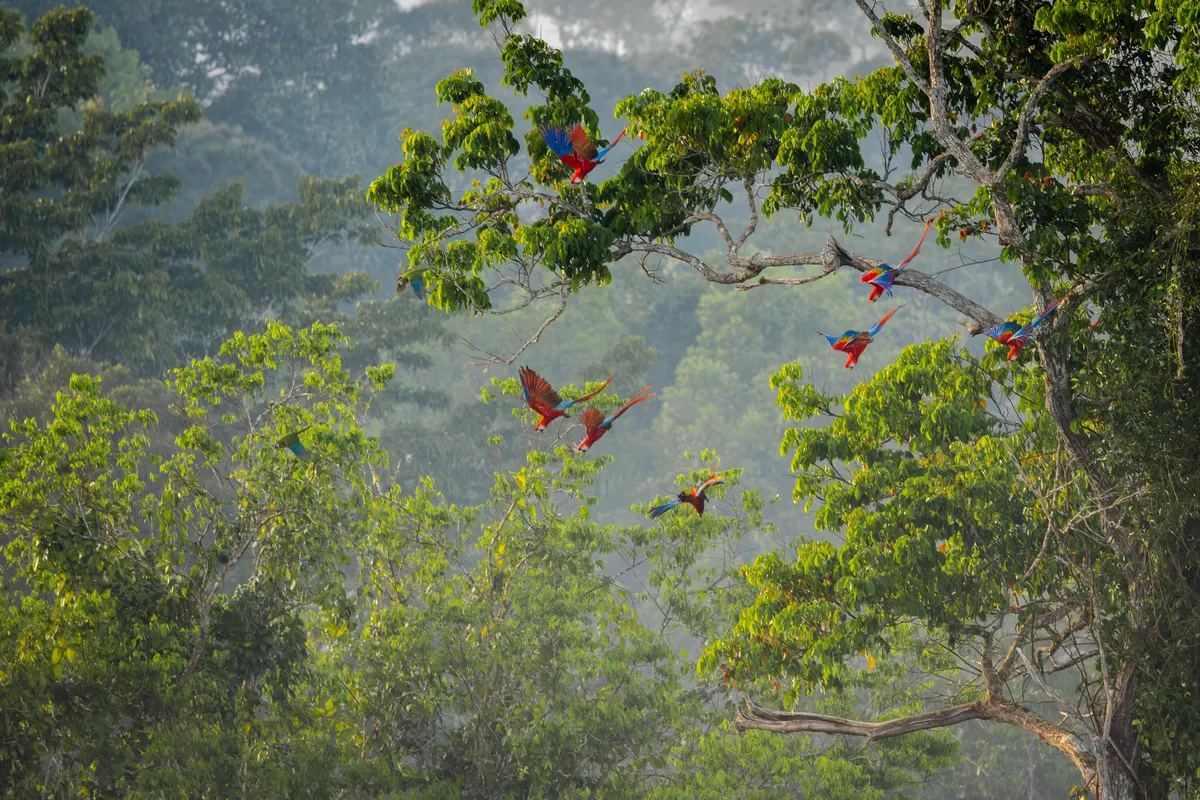
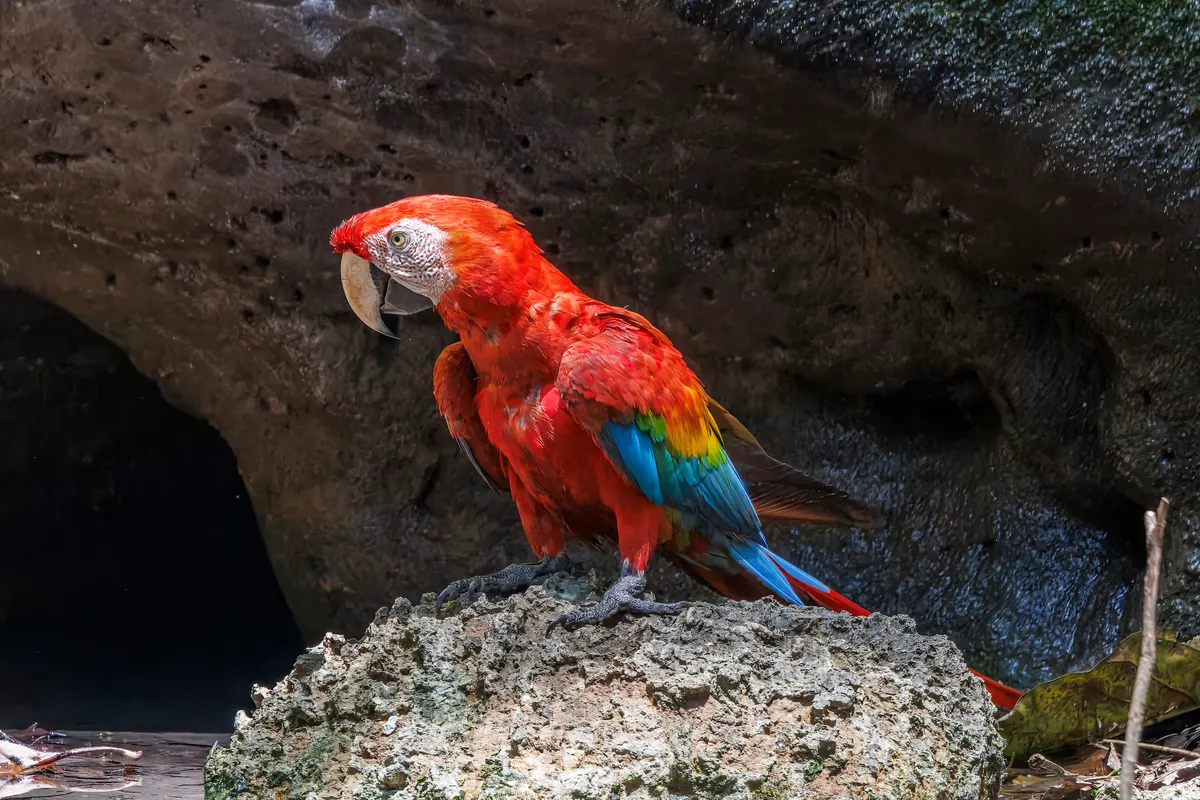
Their plumage is a vivid, warning-coloration tapestry. The head, massive shoulders, and chest are a brilliant, solid scarlet red. The greater wing coverts exhibit a stark, bright yellow band, which transitions into deep, iridescent blue flight feathers on the wings and the lower back. Their facial area features a distinct, bare patch of white skin adorned with tiny, almost imperceptible lines of red feathers.
Their most critical anatomical tool is their massive, deeply curved beak. The upper mandible is hinged directly to the skull (prokinesis), granting them immense leverage and a crushing bite force capable of shattering rock-hard Brazil nuts and palm seeds. Their muscular, fleshy tongue is highly dexterous and contains a bone, allowing them to manipulate and perfectly extract the kernel from a shattered shell.
Furthermore, macaws possess zygodactyl feet—two toes point forward, and two toes point backward. This specialized arrangement functions exactly like a human hand, granting them incredible climbing agility and allowing them to firmly grasp, manipulate, and hold complex food items up to their beak while balancing on a single foot high in the canopy.

The scarlet macaw boasts a massive, albeit highly fragmented, geographic range across the Neotropics. They are distributed from southern Mexico (specifically the Selva Maya region), south through Central America (including Honduras, Costa Rica, and Panama), and extensively across the vast Amazon basin of South America, encompassing Colombia, Ecuador, Peru, and Brazil.
They are obligate residents of lowland tropical rainforests, humid evergreen forests, and riparian woodland zones. They heavily rely on primary, undisturbed forest environments because they absolutely require massive, ancient emergent trees (such as the Ceiba tree) that protrude above the main canopy. These ancient giants provide the deep, natural cavities required for nesting and offer unobstructed vantage points for establishing territory and launching long-distance foraging flights.

Scarlet macaws are highly specialized herbivorous frugivores and granivores. Their diet is incredibly diverse, tracking the seasonal fruiting cycles of the rainforest canopy, consisting primarily of large seeds, nuts, fruits, flowers, and nectar.
Unlike toucans or hornbills which swallow fruit whole and disperse the seeds intact, macaws are primarily "seed predators." Their digestive strategy revolves around using their massive beaks to completely destroy the protective pericarp of toxic or heavily armored fruits to consume and digest the nutrient-dense seed kernel within.
A fascinating and critical aspect of their feeding strategy involves geophagy. In regions of the Amazon, particularly the Tambopata region of Peru, hundreds of scarlet macaws and other parrot species congregate daily on massive, exposed clay licks (collpas) along riverbanks. The macaws ingest large quantities of this specific clay. Scientists hypothesize that the clay serves two vital functions: it provides essential dietary sodium absent from their botanical diet, and the clay particles bind to and neutralize the powerful toxic alkaloids present in the unripe seeds they consume, preventing severe poisoning.

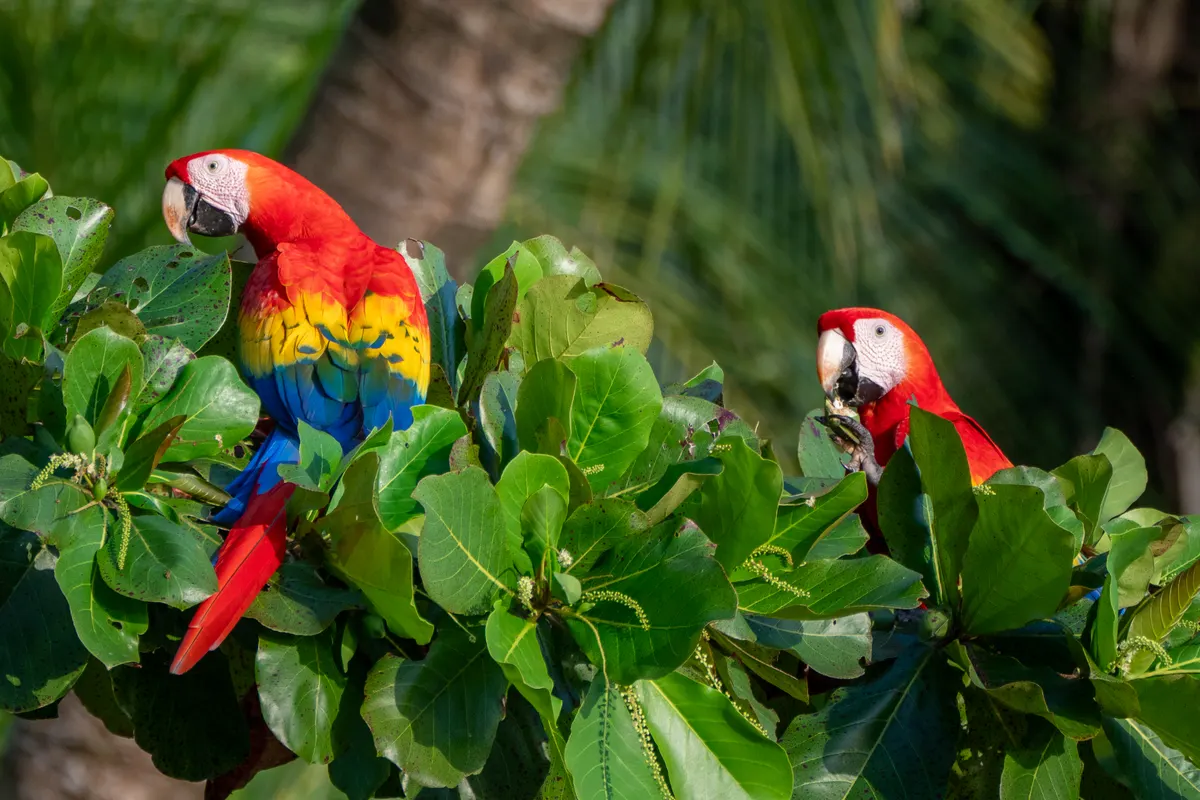
Scarlet macaws are deeply social, intelligent, and highly vocal birds. Their core social unit is the monogamous breeding pair, which frequently mates for life. These pairs are intensely affectionate, constantly engaging in mutual allopreening (grooming each other's feathers) to maintain their bond and eliminate parasites.
Outside of the breeding season, these pairs often aggregate into larger, loose flocks, occasionally numbering in the dozens, particularly when congregating at clay licks or massive fruiting trees.
Their acoustic communication is notoriously loud and raucous. To communicate across miles of dense, acoustically dampening rainforest canopy, they utilize a repertoire of deafening, guttural squawks, screeches, and throaty calls. While incredibly loud, this communication is vital for maintaining contact with their mate during rapid flight and warning the flock of approaching predators. In flight, they are powerful, direct fliers, capable of traveling up to 15 miles a day between roosting and foraging sites, their massive wings beating with a shallow, stiff cadence.

The reproductive strategy of the scarlet macaw is characterized by low fecundity and intense parental investment, making wild populations slow to recover from losses.
They are secondary cavity nesters, meaning they cannot excavate their own nests. They rely entirely on finding natural hollows in massive, dead or dying hardwood trees high above the forest floor. Competition for these rare nesting sites is fierce, and macaws will aggressively defend their chosen cavity from toucans, iguanas, and other parrots.
Following a courtship of mutual feeding and preening, the female lays a small clutch of 1 to 4 white eggs. The female assumes sole responsibility for incubation, which lasts approximately 24 to 28 days, while the male dutifully regurgitates foraged food to sustain her. The chicks hatch entirely naked, blind, and helpless. Both parents frantically forage to feed the rapidly growing chicks, which remain in the nest for an astonishing 3 to 4 months before fledging. Even after leaving the nest, the juvenile macaws remain dependent on their parents for up to a year to learn the complex spatial maps required to locate fruiting trees across the vast jungle. In the wild, scarlet macaws exhibit profound longevity, living 40 to 50 years, and routinely exceeding 70 years in captivity.
(Population and conservation trend data sourced from the IUCN Red List of Threatened Species)
The IUCN Red List currently evaluates the scarlet macaw (Ara macao) globally as a species of "Least Concern" due to its massive distribution across the Amazon basin. However, this global assessment obscures severe, critical localized extinctions, particularly for the northern subspecies (Ara macao cyanoptera) in Central America, which is highly endangered.
The primary driver of their decline is the rampant, accelerating deforestation of the Neotropics for cattle ranching, logging, and agriculture, which destroys both their food sources and, critically, the ancient trees they require for nesting.
Compounding habitat loss is the devastating impact of the illegal wildlife trade. Due to their breathtaking beauty and high intelligence, scarlet macaw chicks are ruthlessly poached from their nests to supply the lucrative black market for exotic pets. Poachers frequently cut down the entire nesting tree to access the chicks, permanently removing critical nesting habitat from the ecosystem. Natural predators include harpy eagles and jaguars, but these pale in comparison to human impacts. Robust conservation efforts, including the installation of artificial nest boxes, aggressive anti-poaching patrols, and ecotourism initiatives that make wild macaws more valuable alive than captured, are essential to securing the future of this iconic rainforest species.
Scarlet macaws can live more than 50 years in the wild.
They use their feet like hands to hold food.
Macaw pairs often stay together for many years.
Their loud calls can be heard far across the rainforest.
Scarlet macaws are bright red, yellow, and blue.
They nest in holes high up in old trees.
Select a question to reveal the answer.
A parrot is a bird with a hooked beak and feet that can grip branches. The scarlet macaw is one of the largest and most colorful parrots.
Scarlet macaws live in tropical rainforests from southern Mexico through Central America and into the Amazon region of South America.
Scarlet macaws eat fruits, nuts, seeds, and flowers. Their strong beaks crack open hard nuts.
Scarlet macaws are about 32 to 36 inches long including their long tail feathers.
Scarlet macaws are listed as Least Concern overall, but forest loss and illegal pet trade have reduced numbers in some regions.
Wild scarlet macaws may live 40 to 50 years. In human care they can live even longer.
Many parrots can copy sounds. Scarlet macaws are better known for loud natural calls than for mimicking human speech.