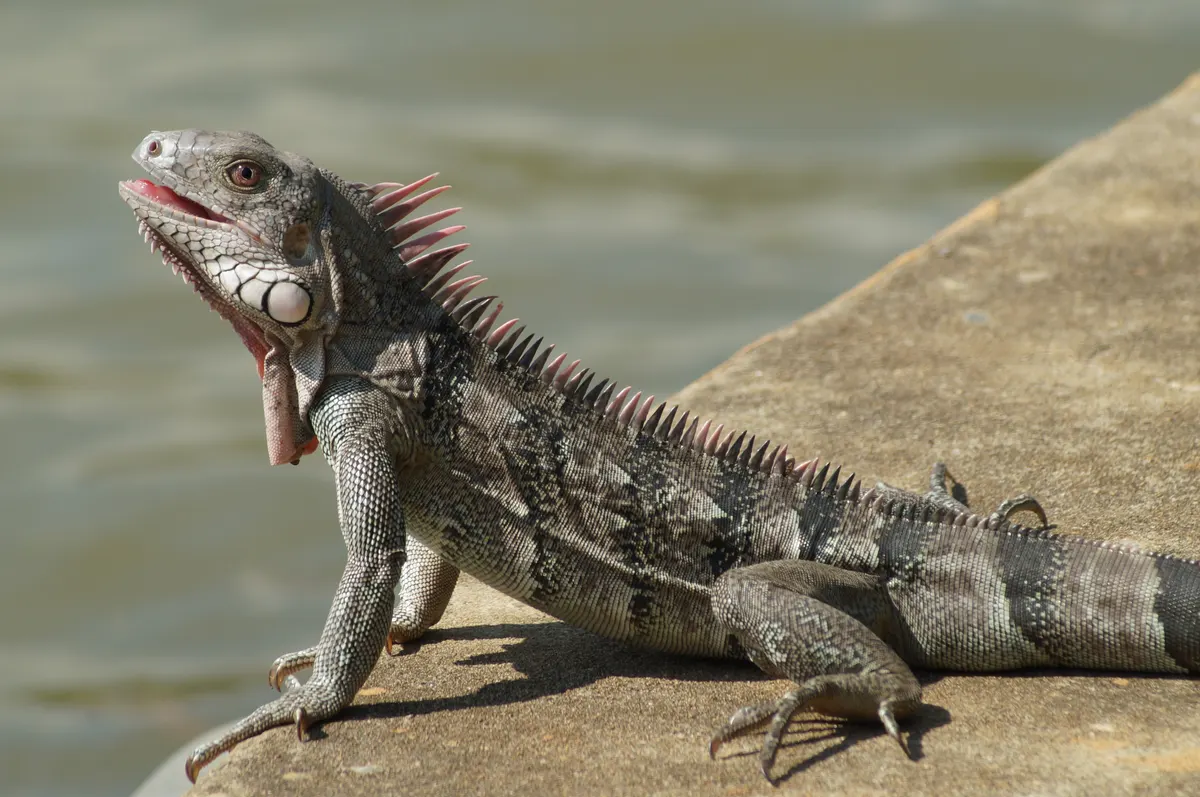
While often observed basking in close proximity to one another on prime branches, green iguanas do not form truly cohesive, cooperative social units. Their social dynamics are primarily defined by rigid, aggressive territoriality, particularly among mature males.
A dominant male will establish and fiercely defend a specific territory, usually a large tree with excellent basking spots and access to females. When a rival male intrudes, a highly ritualized, intense aggressive display ensues. The defending male will laterally compress his body to appear larger, violently flare his massive dewlap, stiffen his legs, and engage in rapid, rhythmic head-bobbing. If the intruder does not submit and retreat, the encounter escalates to brutal physical combat, involving violent tail-whipping, powerful biting, and wrestling that can result in severe lacerations or missing digits.
Their defensive behavior against predators is equally dynamic. If threatened by a bird of prey or a climbing snake, an iguana's first line of defense is its unique camouflage, remaining perfectly motionless to blend into the foliage. If discovered, their primary escape tactic is to launch themselves directly from the high canopy, often plunging 40 feet or more, into the river below. They are exceptionally strong swimmers, tucking their legs against their body and utilizing their massive, muscular tail for rapid, serpentine propulsion, capable of remaining submerged for up to 30 minutes to evade pursuit. If cornered on land, they will employ their whip-like tail, which can strike with enough force to break the skin of a predator, and utilize their razor-sharp claws and teeth. Like many lizards, they possess the ability to perform caudal autotomy; if a predator grasps their tail, they can voluntarily fracture a specific vertebra, allowing the tail to break off and writhe, distracting the predator while the iguana escapes to slowly regenerate a new, albeit imperfect, cartilaginous tail.