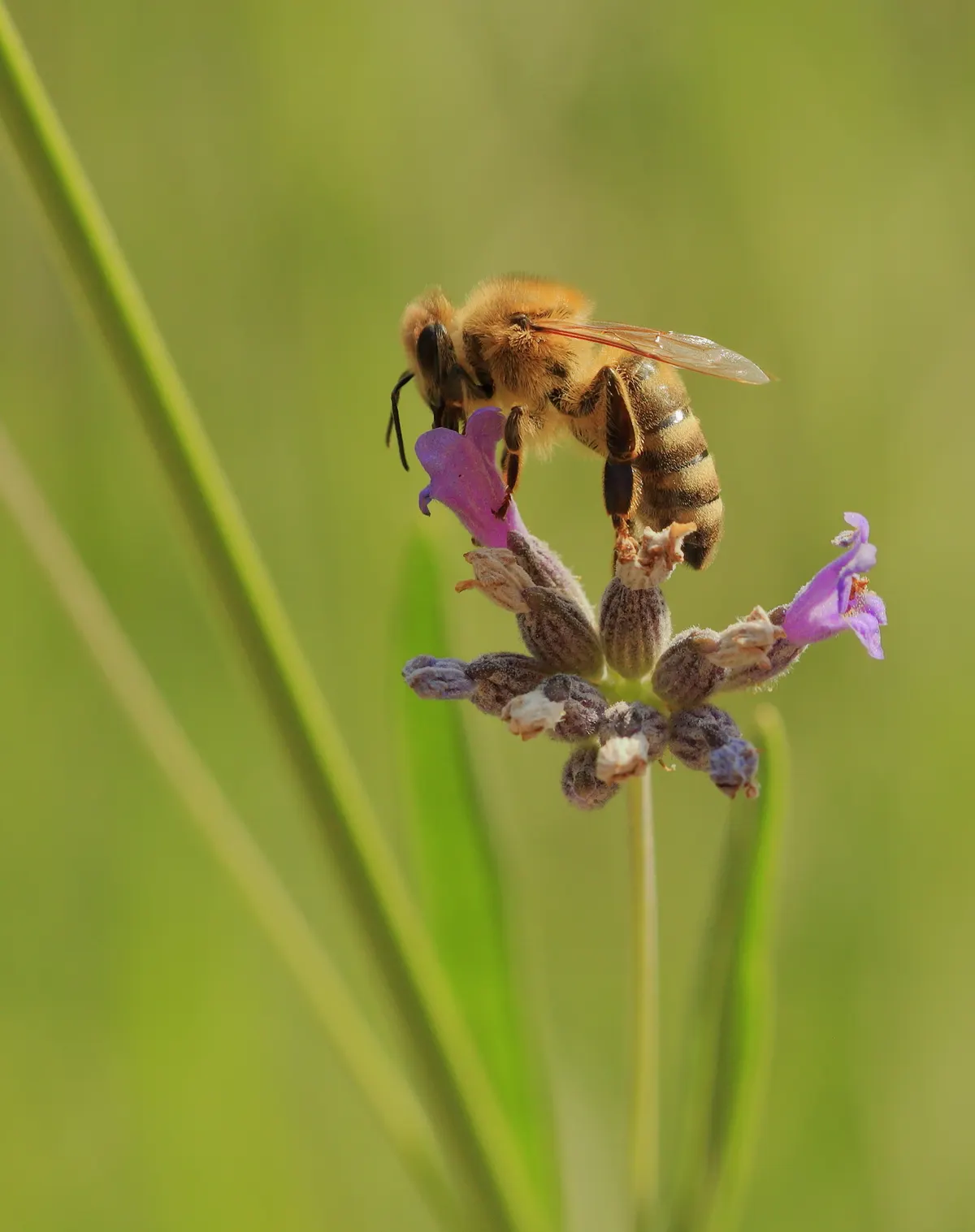
The honeybee is small — 0.4 to 0.8 inches — but robustly built, its body covered in dense, branched hairs that trap pollen. The head is a sensory command center, with two large compound eyes of thousands of lenses (able to read polarized light for navigation even under cloud), three simple eyes for light intensity, and whip-like antennae that detect floral scents and pheromones. The thorax anchors the wings and three pairs of legs, and the worker's hind legs carry the corbicula, or "pollen basket," a concave, hair-fringed structure for hauling large pollen loads; powerful flight muscles beat the wings about 200 times a second. The abdomen holds the "honey stomach" (crop) for carrying nectar, wax glands for building comb, and, in females, a stinger. It belongs to the family Apidae, genus Apis; bees evolved from predatory wasps around 120 million years ago, turning to nectar and pollen as flowering plants radiated.