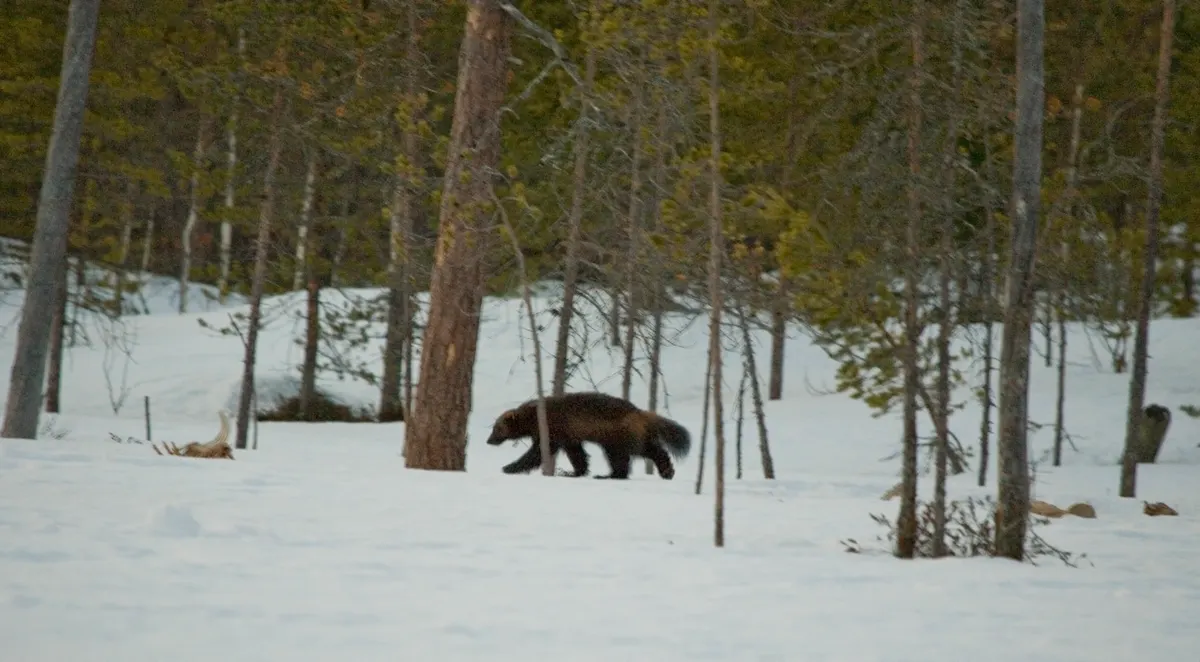
Wolverine walking through snowy boreal forest
Wolverines are the largest land mustelids, built for crushing frozen bone.
MammaliaLeast Concern

Wolverine Facts

Wolverines have the strongest bite force relative to body size among carnivores, capable of crushing frozen bone and meat.

The wolverine is the largest land-dwelling member of the weasel family, built for crushing frozen bone and traversing deep snow across boreal forests and arctic tundra in North America, Europe, and Asia.

By · Updated

Quick Facts

Wolverine at a glance

Gulo guloCarnivoraMustelidae

About their home

Kind of animal

Mammalia

Where they live

What they eat

How safe?

Least Concern

Size and speed

How heavy

20 pounds – 55 pounds

How long

26 inches – 34 inches

How fast

Up to 30 mph in short bursts

Lifespan

5 to 13 years

Core article

Wolverine: ecology and life history

A closer look at habitat, diet, behavior, reproduction, and conservation.

Start here

Wolverine

The wolverine (Gulo gulo) is the largest land member of the weasel family, Mustelidae, and one of the toughest predators of the boreal and subarctic wild. Rarely over 55 pounds, this compact, heavily muscled omnivore has jaws strong enough to crush frozen bone, will drive grizzly bears and wolf packs off a carcass, and patrols territories spanning hundreds of square miles of brutal country. Its many names — "glutton," "skunk bear," "carcajou" — all point to raw endurance and outsized ferocity.

The Largest of the Weasels, Built for Cold

Wolverines are stocky and powerful, 26 to 34 inches in body plus a bushy tail, males 26 to 55 pounds and females about 30% smaller. The skull is broad and reinforced, driving masseter and temporalis muscles that generate enough bite force to shatter frozen bone; blade-like carnassials and inward-rotated molars improve bone-cracking leverage. The fur is a dense, oily underfur under long, coarse guard hairs, and it is uniquely hydrophobic — moisture beads and sheds rather than soaking in — so it stays virtually frost-proof, which is why Arctic peoples prized it for parka-hood trim that resists ice from breath. The paws are oversized natural snowshoes that, with semi-retractile claws, let a wolverine travel over deep, soft snow where heavier wolves and moose flounder. It is the only living member of its genus, sister to the martens and a relative of otters and badgers.

Where Wolverines Live

Wolverine in boreal forest and taiga wilderness
Wolverines need remote forests with persistent spring snow for denning.

Wolverines inhabit forest, taiga, alpine tundra, and subarctic wilderness across the circumpolar north — in North America from Alaska through the Yukon and across the Canadian boreal belt into small, isolated populations in the northern Cascades and Rockies of the contiguous U.S., and in Eurasia through northern Scandinavia, Russia's taiga and Siberia, and into northern Mongolia. They are obligate animals of country with persistent spring snow cover, which they need for denning and food caching, and a single male's territory typically spans 200 to 600 square kilometers, overlapping the ranges of two or three females.

What Wolverines Eat

Wolverine scavenging on a carcass in winter
Carrion from moose and caribou forms the backbone of the wolverine diet.

Wolverines are opportunistic omnivores with a strong scavenging bias. Carrion — especially caribou, moose, and deer killed by wolves, grizzly bears, or winter — is the dietary backbone, topped up with hares, ground squirrels, voles, eggs, berries, and roots in the brief northern summer. Despite their size they are capable predators, routinely killing caribou calves and sometimes adult caribou or young moose mired in deep snow, exploiting their own superior float on soft snow to run heavier prey down. Caching is critical: they store surplus meat under snow and ice across the territory and use those powerful jaws to open the frozen caches when other food fails in deep winter.

Behavior: Solitary, Territorial, and Fearless

Adult wolverine carrying a kit in its mouth
A mother wolverine carries a kit, a behavior seen when relocating young between den sites.

Wolverines are fiercely solitary and territorial — males intolerant of other males but overlapping several female ranges for mating — and mark boundaries with anal-gland scent, urine, and abdominal rubbing. Their ferocity is earned: they steal kills from wolf packs, tree black bears, and face down grizzlies at carcasses, a calculated strategy for a mid-sized predator that can't afford to lose scavenged food. Predominantly crepuscular and nocturnal but active at any hour, they are restless travelers, capable of 15 miles in a day and crossing high winter passes, their movements driven by food rather than any fixed schedule.

Life Cycle: Kits Born in a Snow Den

Young wolverine kit in boreal habitat
Kits are born blind in snow dens between February and April.

Mating runs May to August, but wolverines use delayed implantation — the embryo doesn't attach until the following winter — so active gestation is only 30 to 50 days, with birth in a snow den between February and April. Litters are two to three kits (rarely four), born blind and furred at about 3 ounces, nursed in the den for eight to ten weeks before they emerge. Kits accompany the mother on foraging trips by summer and become independent at five to seven months, reaching sexual maturity at two to three years. Wolverines live 5 to 13 years in the wild, mortality driven by trapping, starvation, and clashes with larger predators.

Conservation: Least Concern Globally, Threatened in the Lower 48

Wolverine crossing a gravel riverbar with Arctic mountains in the background
A single male may patrol 200 to 600 square kilometers of wilderness.

The wolverine is Least Concern globally, with an estimated 25,000 to 30,000 animals — but that figure masks sharp regional declines. In the contiguous U.S. it is considered threatened, with perhaps 300 or fewer surviving in fragmented mountain habitat in Montana, Idaho, Wyoming, and Washington. Climate change is the primary long-term threat: wolverines depend on deep, persistent spring snowpack for denning, and warming is projected to cut suitable denning habitat by an estimated 30 to 60% within the century. Trapping, habitat fragmentation by roads and resource extraction, and low reproductive rates add pressure, so conservation focuses on protecting large, connected wilderness corridors that let animals disperse between isolated populations.

References and Authoritative Sources

Wolverine: classification and fun facts

Classification

Scientific Taxonomy
  1. Kingdom

    Animalia

  2. Phylum

    Chordata

  3. Class

    Mammalia

  4. Order

    Carnivora

  5. Family

    Mustelidae

  6. Genus

    Gulo

  7. Species

    G. gulo

Did You Know?

Fun Facts

1

Wolverines have the strongest bite force relative to body size among carnivores, capable of crushing frozen bone and meat.

2

A single male wolverine may patrol a territory of up to 240 square miles — larger than the city of Chicago.

3

Wolverine fur is hydrophobic and frost-resistant, making it prized by indigenous peoples for lining parka hoods.

4

Despite weighing only 20 to 55 pounds, wolverines have been documented driving grizzly bears and wolf packs away from kills.

5

Wolverines can travel up to 15 miles a day through deep snow using their oversized paws as natural snowshoes.

6

Female wolverines use delayed implantation, timing births to coincide with maximum food availability in spring.

Common Questions

FAQ about Wolverine

Select a question to reveal the answer.

What is a wolverine?

A wolverine is the largest land-dwelling member of the weasel family (Mustelidae). It is a powerful, solitary predator and scavenger found in boreal forests and arctic tundra across the Northern Hemisphere.

Where do wolverines live?

Wolverines inhabit forest and tundra regions across Canada, Alaska, Scandinavia, Russia, and Mongolia. They require vast, remote wilderness with persistent snow cover.

What do wolverines eat?

Wolverines are omnivores that eat carrion, small mammals, birds, berries, and roots. They can also kill prey much larger than themselves, including caribou calves and weakened adult deer.

How strong is a wolverine?

Wolverines possess the strongest bite force relative to body size among carnivores, with jaws capable of crushing frozen bone. They have been observed driving grizzly bears and wolf packs away from carcasses.

Are wolverines related to wolves?

No. Despite the similar name, wolverines are mustelids (weasel family), not canids. They are more closely related to otters, badgers, and mink than to wolves.

How big do wolverines get?

Wolverines measure 26 to 34 inches (65–87 cm) in body length and weigh 20 to 55 pounds (9–25 kg). Males are significantly larger than females, sometimes weighing nearly twice as much.

Show 6 more questionsExpand
Are wolverines dangerous to humans?

Wolverines are extremely shy and almost always avoid humans. Documented attacks on people are nearly nonexistent. Their ferocity is directed at other predators competing for food.

Why are wolverines called gluttons?

The name 'glutton' comes from the wolverine's habit of gorging on large amounts of food when available and caching the rest under snow for later. This behavior is a survival strategy in food-scarce environments.

How far do wolverines travel?

Wolverines are among the most mobile land mammals, covering up to 15 miles per day. Males defend territories of 200+ square miles, routinely crossing mountain ranges and frozen rivers.

How long do wolverines live?

Wolverines live 5 to 13 years in the wild and up to 17 years in captivity. High mortality comes from trapping, starvation during severe winters, and conflicts with larger predators.

Are wolverines endangered?

The wolverine is listed as Least Concern globally by the IUCN, but many regional populations are declining. In the contiguous United States, they are considered a threatened species due to habitat loss and climate change.

What is delayed implantation in wolverines?

Female wolverines mate in summer but delay embryo implantation until winter. The embryo only begins developing if the female has enough body fat, ensuring kits are born in spring when food is most abundant.