Sarcophilus harrisii taranna
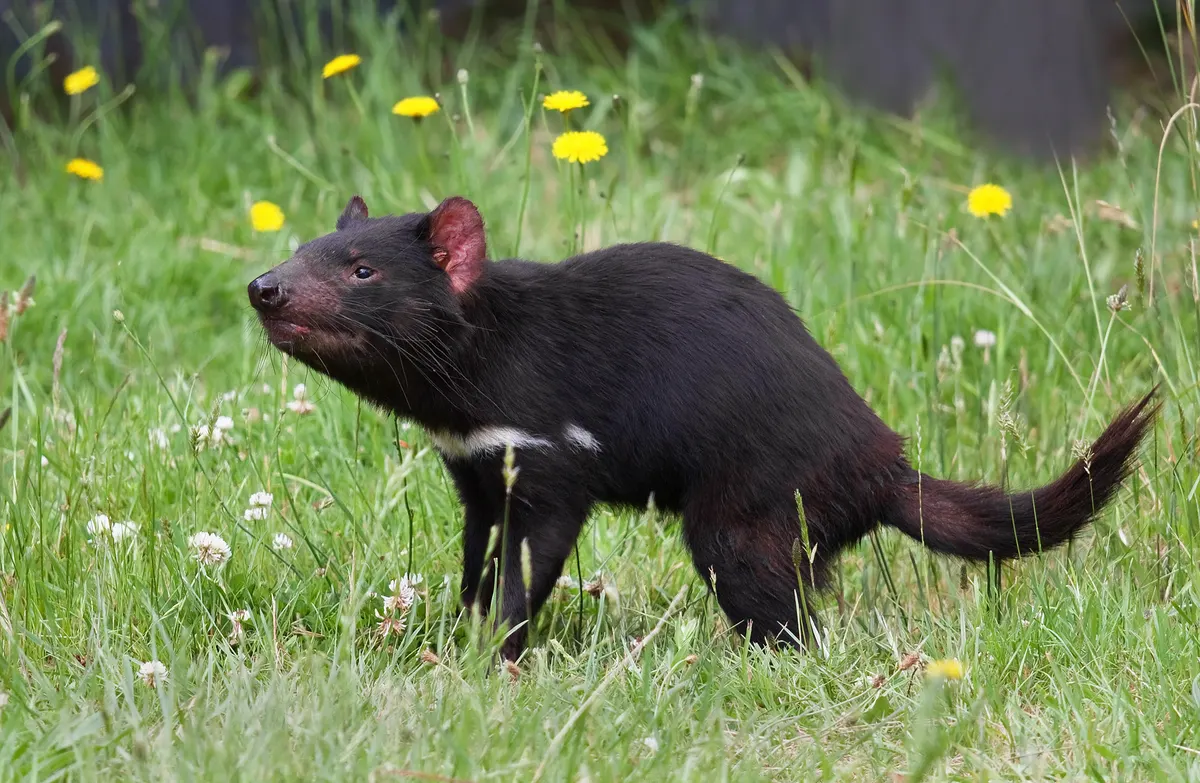
Tasmanian devils are stocky nocturnal marsupials and the largest living carnivorous marsupials.
MammaliaEndangered

Tasmanian Devil Facts

A Tasmanian devil's bite is so powerful relative to its body size that it can crush through bone with ease.

Tasmanian devils are stocky nocturnal marsupials and the largest living carnivorous marsupials. They feed heavily on carrion, using powerful jaws and loud communal displays around carcasses, while a contagious facial tumor disease remains a major conservation threat.

By · Updated

Quick Facts

Tasmanian Devil at a glance

Sarcophilus harrisiiDasyuromorphiaDasyuridae

About their home

Kind of animal

Mammalia

Where they live

What they eat

How safe?

Endangered

Size and speed

How heavy

9 pounds – 26 pounds

How long

20 inches – 31 inches

How fast

Up to 15 mph for short distances

Lifespan

5 to 6 years

Core article

Tasmanian Devil: ecology and life history

A closer look at habitat, diet, behavior, reproduction, and conservation.

Start here

Introduction

In the dense, shadowy underbrush of Australia's island state lurks a creature that has captivated and terrified human observers for centuries: the Tasmanian devil (Sarcophilus harrisii). Earning its demonic moniker from early European settlers who were unsettled by its unearthly, screeching vocalizations in the dead of night, this stocky, black-furred marsupial is the undisputed apex scavenger of its environment.

As the largest surviving carnivorous marsupial in the world, the Tasmanian devil boasts a bite force that defies its modest, dog-like stature, allowing it to crush through solid bone with chilling ease. Yet, beneath their ferocious reputation and chaotic feeding frenzies, devils are highly complex, solitary wanderers that play a crucial ecological role in keeping their native forests free of disease-ridden carrion. Today, this iconic survivor faces an existential crisis, battling a bizarre and devastating transmissible cancer that threatens to silence its iconic screams forever.

Taxonomy and Evolution

The evolutionary history of the Tasmanian devil is deeply rooted in the ancient isolation of the Australian continent, where marsupials evolved to fill the ecological niches occupied by placental mammals elsewhere.

  • Kingdom: Animalia
  • Phylum: Chordata
  • Class: Mammalia
  • Order: Dasyuromorphia
  • Family: Dasyuridae
  • Genus: Sarcophilus
  • Species: S. harrisii

The Tasmanian devil is a member of the family Dasyuridae, a group that includes other carnivorous marsupials like quolls and the extinct thylacine (Tasmanian tiger). The genus name Sarcophilus literally translates to "flesh-lover," a nod to its highly specialized carnivorous diet. While fossil evidence indicates that devils were once widespread across mainland Australia, they were driven to extinction there roughly 3,000 years ago, likely due to a combination of shifting climates and the introduction of the dingo. Today, their natural range is entirely restricted to the island of Tasmania.

Anatomy and Physical Characteristics

A Tasmanian devil resembles a small, heavily built dog, characterized by a squat, muscular frame and a disproportionately large, broad head. Adults typically measure between 20 and 31 inches in body length and stand about 12 inches tall at the shoulder. They exhibit significant sexual dimorphism, with males weighing up to 26 pounds, while females are notably smaller, averaging around 9 to 15 pounds.

Their most distinctive anatomical feature is their jaws. Relative to its body size, the Tasmanian devil possesses one of the strongest bite forces of any living terrestrial mammal. Powered by massive temporalis muscles that attach to a robust sagittal crest on the skull, their jaws open to a staggering 80-degree angle. This extreme gape and crushing power allow them to sheer through thick hide, shatter ribs, and pulverize the skulls of their prey, consuming marrow, fur, and bone without digestive issue.

Their coarse fur is primarily black, often marked with striking white patches across the chest or rump. Like many marsupials, devils store excess body fat in their tails; a thick, plump tail is a visual indicator of a healthy, well-fed devil, while a thin tail signals starvation. Due to their nocturnal lifestyle, they possess long, sensitive whiskers for navigating in absolute darkness and an incredibly acute sense of smell to locate rotting carrion from miles away.

Habitat and Distribution

Tasmanian Devil in its natural habitat
Tasmanian Devil is recorded in temperate forest, coastal scrubland, and grassland habitats.

The Tasmanian devil is entirely endemic to the island state of Tasmania, located off the southeastern coast of the Australian mainland. They are highly adaptable to a variety of environments across the island, occupying a wide range of biomes.

They are most abundant in coastal scrublands, dry sclerophyll forests, and mixed temperate rainforests, where dense undergrowth provides ample cover for sleeping during the day and raising their young. They can also be found in open grasslands, agricultural pastures, and forestry plantations, wherever reliable food sources can be located. They avoid only the highest, most barren alpine peaks and highly urbanized city centers.

Diet and Feeding Strategies

Three Tasmanian devils feeding together at a conservation park
Tasmanian devils are opportunistic carnivores that consume carrion and prey such as wallabies and wombats.

The Tasmanian devil is an opportunistic carnivore and the ultimate scavenger. While they are capable of hunting live prey such as small wombats, wallabies, birds, reptiles, and large insects, the vast majority of their diet consists of carrion. They are nature’s cleanup crew, efficiently disposing of dead animals before maggots and disease can take hold in the ecosystem.

Devils are notoriously voracious eaters; a hungry devil can consume up to 40% of its own body weight in a single feeding session, gorgeing itself in a matter of minutes. When a large carcass is discovered, multiple devils will converge on the site. What follows is a highly aggressive, chaotic feeding frenzy characterized by intense vocalizations, lunging, and vicious biting. This seemingly chaotic behavior is actually a complex social hierarchy display designed to establish dominance and feeding rights without inflicting lethal injuries. Their bone-crushing jaws ensure that absolutely nothing is wasted; they consume the meat, organs, fur, and bones, leaving zero trace of the carcass behind.

Social Structure and Behavior

Tasmanian Devil with young
Documented Tasmanian Devil behavior includes scavenging, nocturnal foraging, and loud vocalizations.

Tasmanian devils are primarily solitary and nocturnal. They do not form packs or family groups, preferring to roam independently across overlapping home ranges that can span up to 20 square kilometers. During the day, they shelter in hollow logs, dense brush, or abandoned wombat burrows.

Despite their solitary nature, they have a highly developed system of communication used primarily during encounters at a carcass or during the mating season. Their vocal repertoire is famously unsettling, consisting of raspy coughs, low growls, high-pitched shrieks, and an echoing scream that gave the animal its name.

When threatened or highly stressed, devils perform a wide, yawning display. While it appears highly aggressive and exposes their massive teeth, this "yawn" is actually a sign of fear and uncertainty. They also release a pungent, foul-smelling odor when stressed, similar to a skunk, though not sprayed.

Life Cycle and Reproduction

Juvenile Tasmanian devil playing in shallow water at Mole Creek
After a gestation of about 21 days, Tasmanian devil joeys continue developing in the mother's pouch before emerging as juveniles.

The reproductive cycle of the Tasmanian devil is an intense and ruthless struggle for survival. Mating occurs in March, and the males are highly aggressive, often physically dragging females into dens and guarding them for days to ensure paternity.

Devils are marsupials, meaning their young are born in a highly underdeveloped, embryonic state. After a mere 21-day gestation period, the female gives birth to an astonishing 20 to 30 tiny joeys, each roughly the size of a single grain of rice. A frantic race immediately ensues as the blind, hairless babies crawl up the mother's fur to reach her rear-facing pouch. However, the female only has four teats. The first four joeys to attach to a teat will survive; the rest simply perish.

The successful joeys remain firmly attached inside the pouch for about 100 days, growing rapidly on their mother's nutrient-dense milk. After emerging from the pouch, they are left in a secure den while the mother forages. They are fully weaned at around 9 months old and disperse to establish their own territories. In the wild, devils have a tragically short lifespan, typically living only 5 to 6 years, though they can survive up to 8 years in captivity.

Conservation Status and Threats

Tasmanian Devil in its native range
Tasmanian Devil has a documented distribution that includes Australia.

(Population and conservation trend data sourced from the IUCN Red List of Threatened Species)

The Tasmanian devil is currently classified as Endangered by the International Union for Conservation of Nature (IUCN), and their population trend is drastically decreasing.

The primary cause of their decline is a catastrophic transmissible cancer known as Devil Facial Tumor Disease (DFTD). First discovered in 1996, DFTD is spread rapidly through the population via biting during mating and feeding frenzies. The disease causes massive tumors to grow on the face and inside the mouth, eventually preventing the animal from eating and causing death by starvation within months. DFTD has wiped out more than 80% of the wild devil population.

In response, massive conservation efforts are underway. Programs such as the "Save the Tasmanian Devil Program" have established large, disease-free insurance populations in captive breeding facilities and on isolated islands to ensure the species does not go extinct. Researchers are also working tirelessly to develop a vaccine and study small pockets of wild devils that seem to be developing a natural genetic resistance to the tumors.

References and Authoritative Sources

To learn more about the Tasmanian devil and ongoing conservation efforts, consult the following authoritative resources:

Tasmanian Devil: classification and fun facts

Classification

Scientific Taxonomy
  1. Kingdom

    Animalia

  2. Phylum

    Chordata

  3. Class

    Mammalia

  4. Order

    Dasyuromorphia

  5. Family

    Dasyuridae

  6. Genus

    Sarcophilus

  7. Species

    S. harrisii

Did You Know?

Fun Facts

1

A Tasmanian devil's bite is so powerful relative to its body size that it can crush through bone with ease.

2

Newborn Tasmanian devil joeys are no bigger than a grain of rice and must crawl into the mother's pouch immediately after birth.

3

Tasmanian devils communicate through screams, growls, and yawns that can sound ferocious to predators.

4

They can eat up to 40 percent of their own body weight in a single feeding session.

5

Tasmanian devils are the only place on Earth where this species lives in the wild—the island of Tasmania.

6

A transmissible facial tumor disease called DFTD has killed more than 80 percent of the wild population since the 1990s.

Common Questions

FAQ about Tasmanian Devil

Select a question to reveal the answer.

What is a Tasmanian devil?

A Tasmanian devil is the world's largest carnivorous marsupial. It is a stocky, black-furred animal found only on the island of Tasmania, Australia.

Why is the Tasmanian devil called a devil?

Early European settlers named it a devil because of its loud, eerie screams and growls heard in the night, along with its aggressive feeding behavior.

What do Tasmanian devils eat?

Tasmanian devils are carnivores that eat wombats, wallabies, carrion, birds, and reptiles. They often scavenge dead animals and eat bones, fur, and all.

Where do Tasmanian devils live?

Tasmanian devils live only on the island of Tasmania, off the south coast of Australia. They were once found on mainland Australia but disappeared there thousands of years ago.

How strong is a Tasmanian devil's bite?

The Tasmanian devil has the strongest bite relative to body size of any living mammal. It can crush bone and devour an entire carcass, leaving almost nothing behind.

What is a baby Tasmanian devil called?

A baby Tasmanian devil is called a joey. Newborns are tiny—about the size of a grain of rice—and crawl into the mother's pouch to continue developing.

Show 6 more questionsExpand
How long do Tasmanian devils live?

Wild Tasmanian devils usually live 5 to 6 years. In captivity with regular food and veterinary care, they can live up to 8 years.

Are Tasmanian devils endangered?

Yes. Tasmanian devils are listed as Endangered, mainly because of a contagious facial tumor disease called Devil Facial Tumor Disease (DFTD) that has devastated the wild population.

Do Tasmanian devils screech?

Yes. Tasmanian devils make loud screeches, growls, and coughs, especially when competing for food. The sounds can seem terrifying at night in the bush.

Are Tasmanian devils nocturnal?

Yes. Tasmanian devils are mainly active at night when they forage and scavenge for food. During the day they rest in dense bush, logs, or burrows.

What is Devil Facial Tumor Disease?

Devil Facial Tumor Disease is a contagious cancer spread through biting. It causes tumors on the face that prevent the animal from eating, eventually leading to death.

What threatens Tasmanian devils?

The biggest threat is Devil Facial Tumor Disease. Other threats include vehicle strikes on roads, habitat loss, and introduced predators such as foxes.