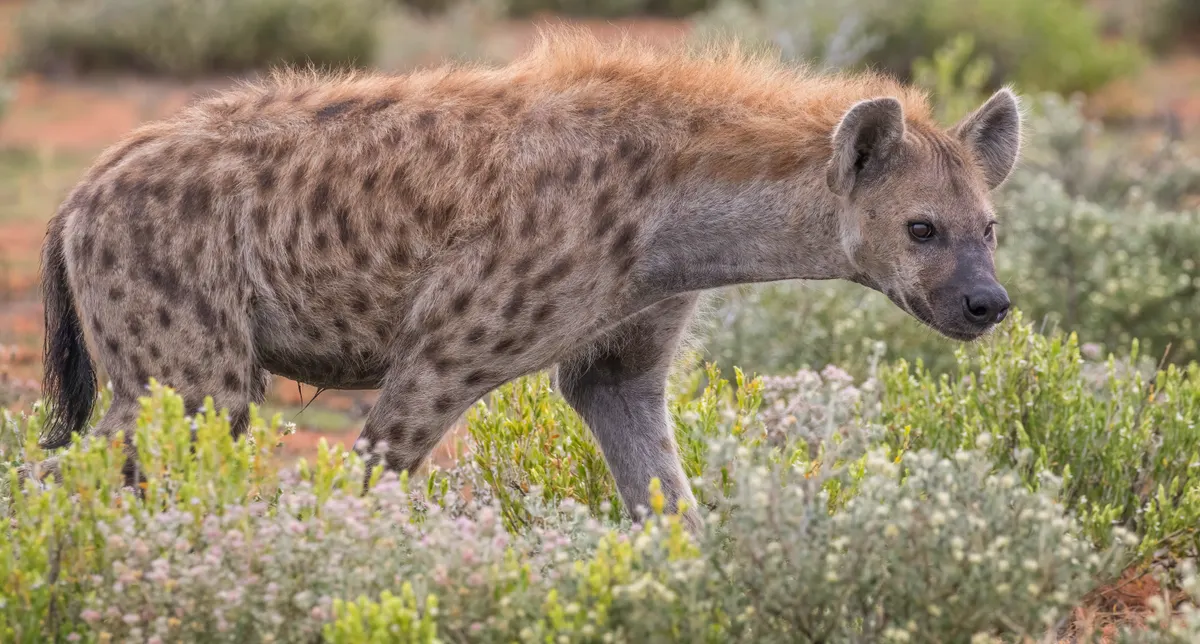
Spotted hyena standing alert in dry grassland in Namibia
Spotted hyenas have sandy fur covered in dark spots and strong, sloping shoulders.
MammaliaLeast Concern

Spotted Hyena Facts

A spotted hyena's giggling 'laugh' is really a sound that shares excitement or stress, not happiness.

Spotted hyenas live in complex female-led clans across sub-Saharan grasslands and open woodland. They are capable cooperative hunters as well as efficient scavengers, with crushing jaws that let them consume bone and extract food other predators leave behind.

By · Published · Updated

Quick Facts

Spotted Hyena at a glance

Crocuta crocutaCarnivoraHyaenidae

About their home

Kind of animal

Mammalia

Where they live

What they eat

How safe?

Least Concern

Size and speed

How heavy

90 pounds – 190 pounds

How long

3 feet – 5.5 feet

How fast

Up to 37 mph in short bursts

Lifespan

Around 12 years

Core article

Spotted Hyena: ecology and life history

A closer look at habitat, diet, behavior, reproduction, and conservation.

Start here

Introduction

The spotted hyena (Crocuta crocuta) is a large African savanna carnivore that both hunts and scavenges. Its jaws can break large bones, and its vocal repertoire includes giggles, whoops, and other calls used in different social contexts.

Far from being mere opportunists, spotted hyenas are active hunters that kill much of their own prey. They live in structured, female-led clans in which rank, alliances, and communication shape access to food and breeding opportunities. Endurance, powerful jaws, and an efficient digestive system also allow them to use carcass parts that many competing carnivores leave behind.

Taxonomy and Evolution

Despite a superficial resemblance to wild dogs, hyenas are not canines. They belong to the suborder Feliformia and are more closely related to cats, mongooses, and civets than to wolves or dogs.

  • Kingdom: Animalia
  • Phylum: Chordata
  • Class: Mammalia
  • Order: Carnivora
  • Family: Hyaenidae
  • Genus: Crocuta
  • Species: C. crocuta

The family Hyaenidae contains four living species: the spotted hyena, striped hyena, brown hyena, and insect-eating aardwolf. The spotted hyena is the only living member of the genus Crocuta. Early hyenas included arboreal, civet-like forms, while the lineage leading to C. crocuta developed the body proportions and endurance associated with pursuing ungulates on open ground.

Anatomy and Physical Characteristics

Spotted hyenas have a sloping back, with longer and more heavily built forequarters than hindquarters. Their limb proportions and gait support sustained travel during hunts.

Adults range from 3 to 5.5 feet in length, stand 2.3 to 3 feet at the shoulder, and weigh about 90 to 190 pounds. Females are generally larger and more muscular than males and rank above adult males in the clan hierarchy.

The skull provides broad attachment areas for large jaw muscles. The bite can shear hide and fracture the bones of large ungulates, giving hyenas access to marrow. Concentrated stomach acid helps them digest bone and other carcass material; indigestible hair is later regurgitated in compact pellets.

Their pelage is coarse and sandy-yellow to reddish-brown, covered in dark, irregular spots that provide excellent camouflage in the dappled shade of the savanna. These spots fade as the animal ages, making older hyenas appear almost uniformly brown.

Habitat and Distribution

Spotted hyena in golden savanna grass at Tarangire, Tanzania
Open grasslands give hyenas room to find prey and follow other hunting animals.

Spotted hyenas occupy a broad range across sub-Saharan Africa, including Kenya, Tanzania, Namibia, Botswana, South Africa, Zambia, Ethiopia, and Uganda. They are among the more widely distributed large African carnivores.

They occur in open savannas, grasslands, acacia woodlands, scrublands, semi-deserts, and mountain areas up to about 13,000 feet. They generally avoid dense tropical rainforest and the driest deserts. The distribution of medium and large ungulates influences where clans forage and establish territories.

Diet and Feeding Strategies

Spotted hyena feeding on small prey remains in the grass
Strong jaws and teeth let a hyena eat meat and crack bones other animals leave behind.

Spotted hyenas are active hunters as well as scavengers. In some ecosystems, hunting accounts for up to 95% of the food they consume. Groups may also displace cheetahs, leopards, or lionesses from carcasses when hyenas have a numerical advantage.

Their primary prey includes medium to large ungulates such as wildebeest, zebra, gazelle, and various antelope species. Depending on the size of the prey, spotted hyenas hunt either alone or in coordinated packs. When hunting a large animal like a zebra, a group will work cooperatively, using a relay system to exhaust their quarry. They are pursuit predators, capable of reaching speeds of up to 37 mph in short bursts and maintaining a steady pace of 6 mph for miles.

Unlike big cats, hyenas do not use retractile claws to hold prey. They rely on pursuit, repeated bites, and group pressure to bring down larger animals. Competition at a carcass can be intense, and a group may consume most of an adult zebra, including many of its bones, in less than half an hour.

Social Structure and Behavior

Adult spotted hyena beside a young cub in the wild
Young hyenas learn their clan's ranks and rules by watching the adults around them.

Spotted hyenas live in fission-fusion groups called clans, which can contain up to 80 individuals. Members separate and regroup while maintaining a shared hierarchy and territory.

Clans are female-dominated: adult females rank above immigrant males, and an alpha female occupies the highest position. Daughters tend to acquire ranks near that of their mother through a process known as maternal rank inheritance.

Most males leave their natal clan after reaching sexual maturity and join another clan. An immigrant male enters below resident adults, and his rank can rise as males that arrived earlier die or leave.

The spotted hyena has a varied vocal repertoire. Its giggling "laugh" is associated with excitement, stress, or submission rather than happiness and is often heard during competition at a carcass. A drawn-out whoop carries over long distances and can bring separated clan members together. Hyenas also deposit glandular paste on grass to mark boundaries and convey individual information.

Life Cycle and Reproduction

Young spotted hyena cub sitting on a dirt track
Cubs stay close to the den for months while the clan helps keep them safe.

Female spotted hyenas have an elongated clitoris, often called a pseudo-penis, through which they urinate, mate, and give birth. The narrow birth canal makes first births particularly risky for both mother and cubs.

After a gestation of roughly 110 days, a female usually gives birth to 1 to 3 cubs. The cubs are born with open eyes and erupted teeth. Littermates may fight over access to milk, and sibling deaths occur in some litters, particularly during periods of limited food.

Hyena milk has high fat and protein content, allowing mothers to leave cubs in a communal den while they travel to forage. Spotted hyenas reach maturity at around 2 to 3 years and typically live about 12 years in the wild; captive individuals may reach 25 years.

Conservation Status and Threats

Spotted hyena crossing the Serengeti grassland in Tanzania
Hyenas travel long distances across their home range to find food and water.

(Population and conservation trend data sourced from the IUCN Red List of Threatened Species)

The spotted hyena is classified as Least Concern by the International Union for Conservation of Nature (IUCN). Its estimated global population is between 27,000 and 47,000 individuals, making it the most numerous large African carnivore.

However, their population trend is categorized as decreasing. Outside of protected national parks and reserves, spotted hyenas face significant threats. As human populations expand and natural habitats are converted into agricultural land, the hyenas' natural prey base dwindles. This leads to increased instances of livestock depredation, bringing hyenas into direct and often fatal conflict with pastoralists and farmers. Retaliatory killings via poisoning, snaring, and shooting are common. In some regions, they are also hunted for body parts used in traditional medicine.

References and Authoritative Sources

To learn more about the spotted hyena, consult the following authoritative wildlife and conservation resources:

Spotted Hyena: classification and fun facts

Classification

Scientific Taxonomy
  1. Kingdom

    Animalia

  2. Phylum

    Chordata

  3. Class

    Mammalia

  4. Order

    Carnivora

  5. Family

    Hyaenidae

  6. Genus

    Crocuta

  7. Species

    C. crocuta

Did You Know?

Fun Facts

1

A spotted hyena's giggling 'laugh' is really a sound that shares excitement or stress, not happiness.

2

Hyena clans can have up to 80 members and are always led by a top female.

3

Their jaws are strong enough to crack open large bones that other predators cannot eat.

4

Spotted hyenas are excellent hunters and catch much of their own food instead of only scavenging.

5

Cubs are born with their eyes open and already have some teeth.

6

Hyenas are more closely related to cats and mongooses than to dogs.

Common Questions

FAQ about Spotted Hyena

Select a question to reveal the answer.

What is a spotted hyena?

A spotted hyena is a large African carnivore with sandy, spotted fur and powerful jaws. It lives in family groups called clans and both hunts and scavenges for food.

Where do spotted hyenas live?

Spotted hyenas live across sub-Saharan Africa in savannas, grasslands, woodlands, and semi-deserts, from Kenya and Tanzania to southern Africa.

What do spotted hyenas eat?

Spotted hyenas are carnivores. They hunt animals such as wildebeest, zebra, and gazelle, and they also scavenge meat and bones left behind by other predators.

Why do hyenas laugh?

The 'laugh' is a giggling call hyenas make when they are excited or nervous, often around food. It helps clan members send messages to each other.

Are spotted hyenas dogs?

No. Even though they look a little like dogs, hyenas belong to their own family, Hyaenidae, and are more closely related to cats and mongooses.

Are spotted hyenas endangered?

Spotted hyenas are listed as Least Concern, but their numbers are slowly dropping in some areas because of habitat loss and conflict with people.