
Ailuropoda melanoleuca / Ailurus fulgens
Giant Panda vs Red Panda
They share bamboo forests and a misleading name, but giant pandas and red pandas are very different mammals with separate evolutionary lineages.
By An Nguyen · Updated
At a glance
Published species data from both WildlifeDB profiles, aligned trait by trait. Size metrics highlight the larger value with a relative bar.
- Scientific name
- Giant PandaAiluropoda melanoleuca
- Red PandaAilurus fulgens
- Classification
- Giant PandaMammalia · Ursidae
- Red PandaMammalia · Ailuridae
- Native range
- Giant PandaAsia
- Red PandaAsia
- Primary habitat
- Giant PandaForest
- Red PandaForest
- Diet
- Giant PandaHerbivore
- Red PandaOmnivore
- Typical food
- Giant PandaBamboo leaves, Bamboo shoots, Bamboo stems, Occasional roots and fruit
- Red PandaBamboo leaves, Bamboo shoots, Berries, Fruit, Eggs
- Body length
- Giant Panda4 feet – 6 feet
- Red Panda20 inches – 26 inches
- Shoulder height
- Giant Panda2 feet – 3 feet at shoulder
- Red Panda12 inches – 16 inches
- Weight
- Giant Panda200 pounds – 300 pounds
- Red Panda8 pounds – 17 pounds
- Top speed
- Giant PandaSlow on ground; strong climber in trees
- Red PandaSlow on ground; agile climber in trees
- Wild lifespan
- Giant Panda14 to 20 years
- Red Panda8 to 10 years
- Social pattern
- Giant PandaBamboo feeding, Solitary living, Tree climbing
- Red PandaTree climbing, Solitary living, Bamboo feeding
- Key adaptations
- Giant PandaPseudo-thumb for gripping bamboo, Strong jaw for crushing stems, Thick fur for cool mountains
- Red PandaFalse thumb for gripping bamboo, Bushy tail for balance, Thick fur for cold mountains
- Conservation
- Giant PandaVulnerable · Increasing
- Red PandaEndangered · Decreasing
- Reproduction
- Giant PandaAbout 95 to 160 days; Usually 1 or 2 cubs
- Red PandaAbout 130 days; Usually 1 to 4 cubs
Two families, one shared name
The giant panda, Ailuropoda melanoleuca, is a bear in the family Ursidae. The red panda, Ailurus fulgens, is the only living member of the family Ailuridae. They are not close relatives, and neither is a version of the other.
The shared name records a shared diet and a shared mountain forest, not kinship. Red pandas were also once called "firefox," which describes the animal rather better than "panda" does. A longer treatment of why the two are not related covers the taxonomic history.
The weight gap is about eighteen to one
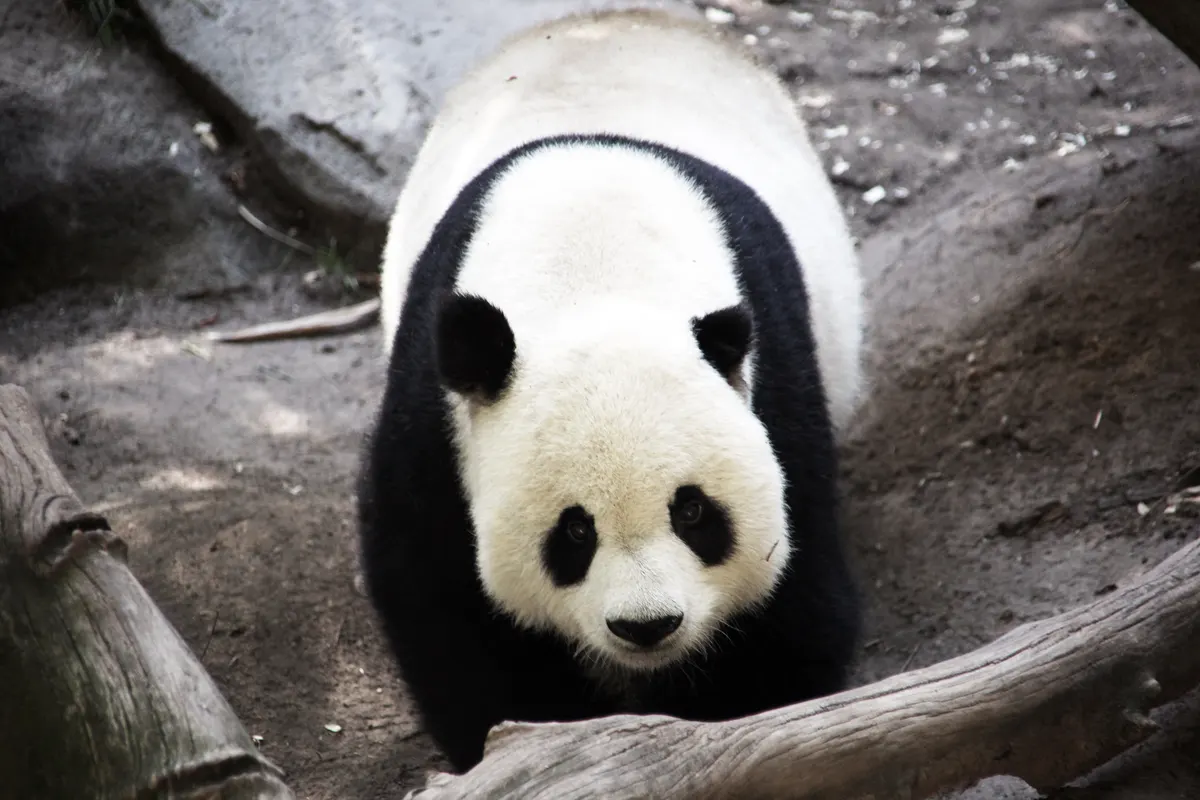
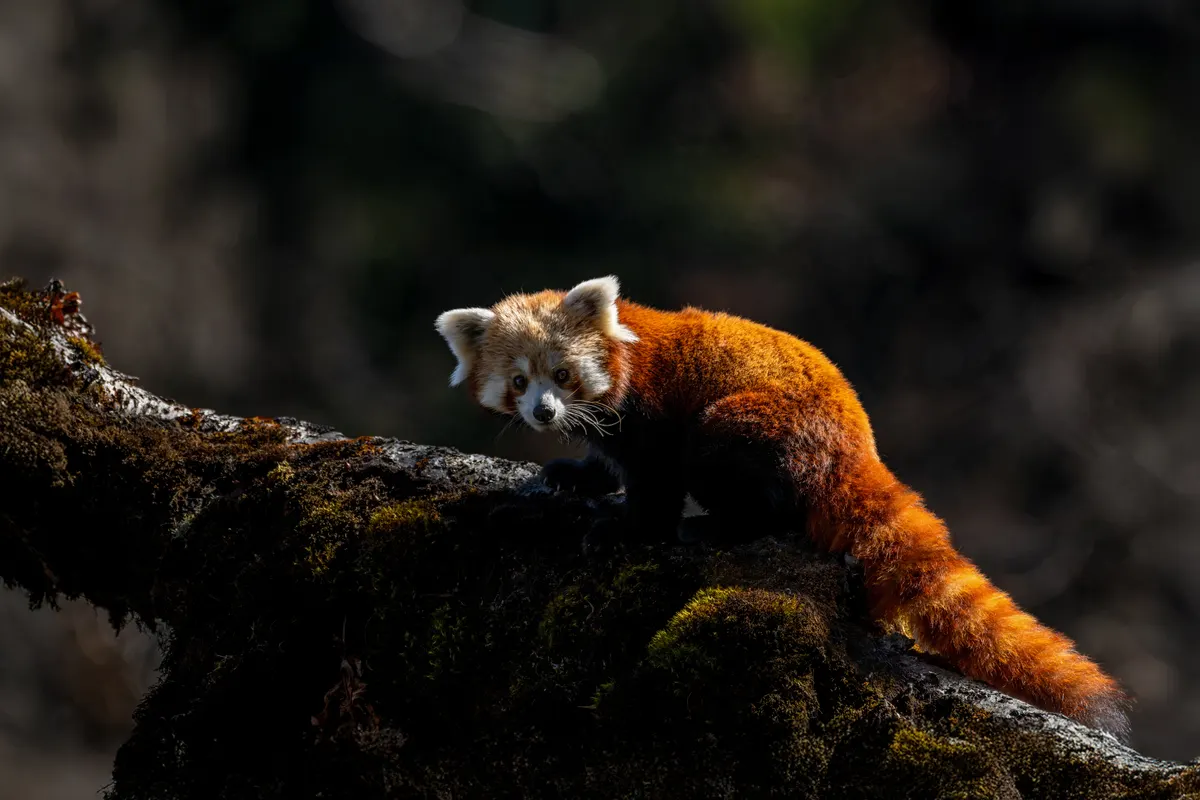
Giant pandas run about 4–6 feet and 200–300 pounds. Red pandas measure about 20–26 inches and 8–17 pounds. At the top of each range the bear is roughly eighteen times the mass.
The giant panda stands about 2–3 feet at the shoulder with the compact, powerful build of a bear. The red panda's 12–16 inch shoulder height and light frame suit a life in branches, and its long ringed tail adds visual length without counting toward body length.
Both grip bamboo with a false thumb
The most striking similarity is anatomical. Both animals have an enlarged wrist bone that works like a thumb, letting them hold a bamboo stem while stripping leaves. Neither inherited it from the other: two lineages arrived at the same solution because both had to handle the same awkward food.
That is convergence, not relatedness, and it is the reason the pair look superficially similar in feeding photographs despite belonging to different families.
A bear on the ground, a climber in the branches
A giant panda is a heavy terrestrial animal that can climb but does most of its feeding on the ground, scent-marks with glands near the tail, and lives solitarily outside breeding and cub rearing. A low-energy lifestyle offsets the poor returns of a bamboo diet; a panda may feed for up to 14 hours a day.
A red panda is tied to branches and tree hollows, using retractable claws to climb and a bushy tail for balance and insulation, and is most active at dawn and dusk. Seeing a red panda high in thin outer canopy is normal. An adult giant panda cannot use that part of the forest at all.
Both mothers raise dependent cubs, and both newborns are small relative to the adult. A newborn giant panda cub is about the size of a stick of butter.
Bamboo only, or bamboo plus eggs and fruit
Bamboo is central for both, but the classifications differ. The giant panda is recorded as a herbivore: bamboo leaves, shoots, and stems, with occasional roots or fruit. Specialised molars and jaw muscles crush tough stems, although the digestive system is still bear-like, which is why so much feeding time is needed.
The red panda is an omnivore: bamboo leaves and shoots plus berries, fruit, eggs, and insects. It can eat up to a third of its body weight in bamboo daily. Despite belonging to the order Carnivora, the giant panda eats almost no meat — the order name describes ancestry, not diet.
For either animal, healthy understory bamboo is the limiting detail. A forest with mature trees but no usable bamboo is not equivalent habitat.
China only, or across the Himalaya
Both live in cool Asian mountain forest with bamboo, but not on the same map. Giant pandas are restricted to a set of forest landscapes in China, where they were once found across much of the south and east.
Red pandas range through Himalayan and adjacent forests in Nepal, India, Bhutan, China, and Myanmar. Their range is wider and their populations are also fragmented.
Vulnerable and rising against Endangered and falling
The giant panda is Vulnerable with an increasing trend. The red panda is Endangered with a decreasing trend. The smaller, less famous animal is in the worse position — a useful correction to the assumption that the giant panda is the more threatened of the two.
Neither is secure. Habitat fragmentation, infrastructure, and localised pressure reduce the continuity of bamboo forest for both, and the red panda's predators include martens and snow leopards as well as people.
The identification rule stays simple: the large black-and-white bear is a giant panda, and the small reddish, long-tailed tree climber is a red panda.