
Ocean life
How Does a Mantis Shrimp Punch So Hard?
A spring, latch, and linkage release stored muscular energy faster than muscle alone can move the striking club.
By An Nguyen · Published · Updated
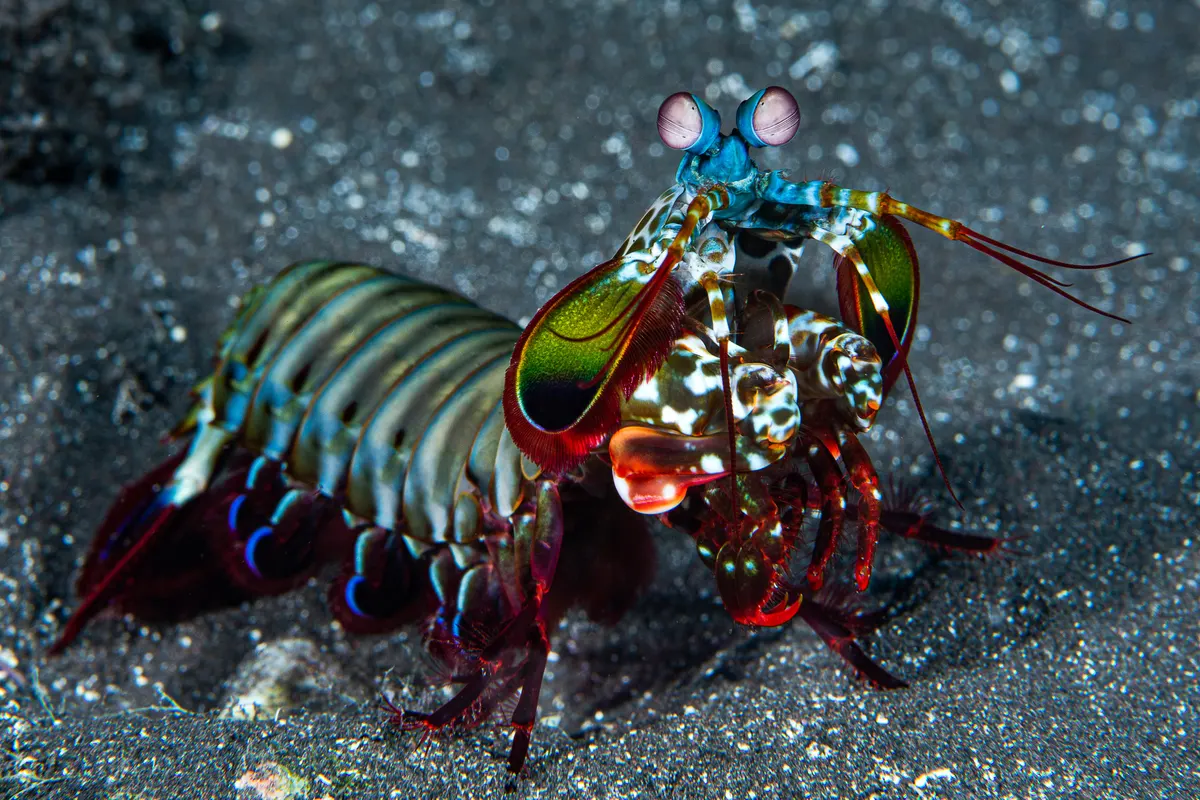
A peacock mantis shrimp punches so hard because its muscles load energy into an elastic part of the exoskeleton before the strike. A latch holds that energy, then a linkage releases it into the club faster than muscle alone could contract. The club's impact can be followed by a second pressure pulse from a collapsing cavitation bubble.
The movement commonly called a "punch" is a spring-powered swing by a specialized raptorial appendage. In measurements of the peacock mantis shrimp, Odontodactylus scyllarus, the club reached roughly 12 to 23 meters per second. The strike can produce two closely spaced force peaks: the direct impact and the collapse of the cavitation bubble.
First, not every mantis shrimp is a puncher
Mantis shrimps are stomatopod crustaceans, not true shrimps and not mantises. Their front appendages come in two broad functional designs. "Spearers" have elongated, barbed parts suited to catching softer, mobile prey. "Smashers" have a thickened heel on the terminal segment that works as a club against snails, crabs, and other hard targets.
The peacock mantis shrimp is a smasher and the species behind many high-speed strike studies. It is therefore more accurate to say that some mantis shrimps smash than to give every species the same punch.
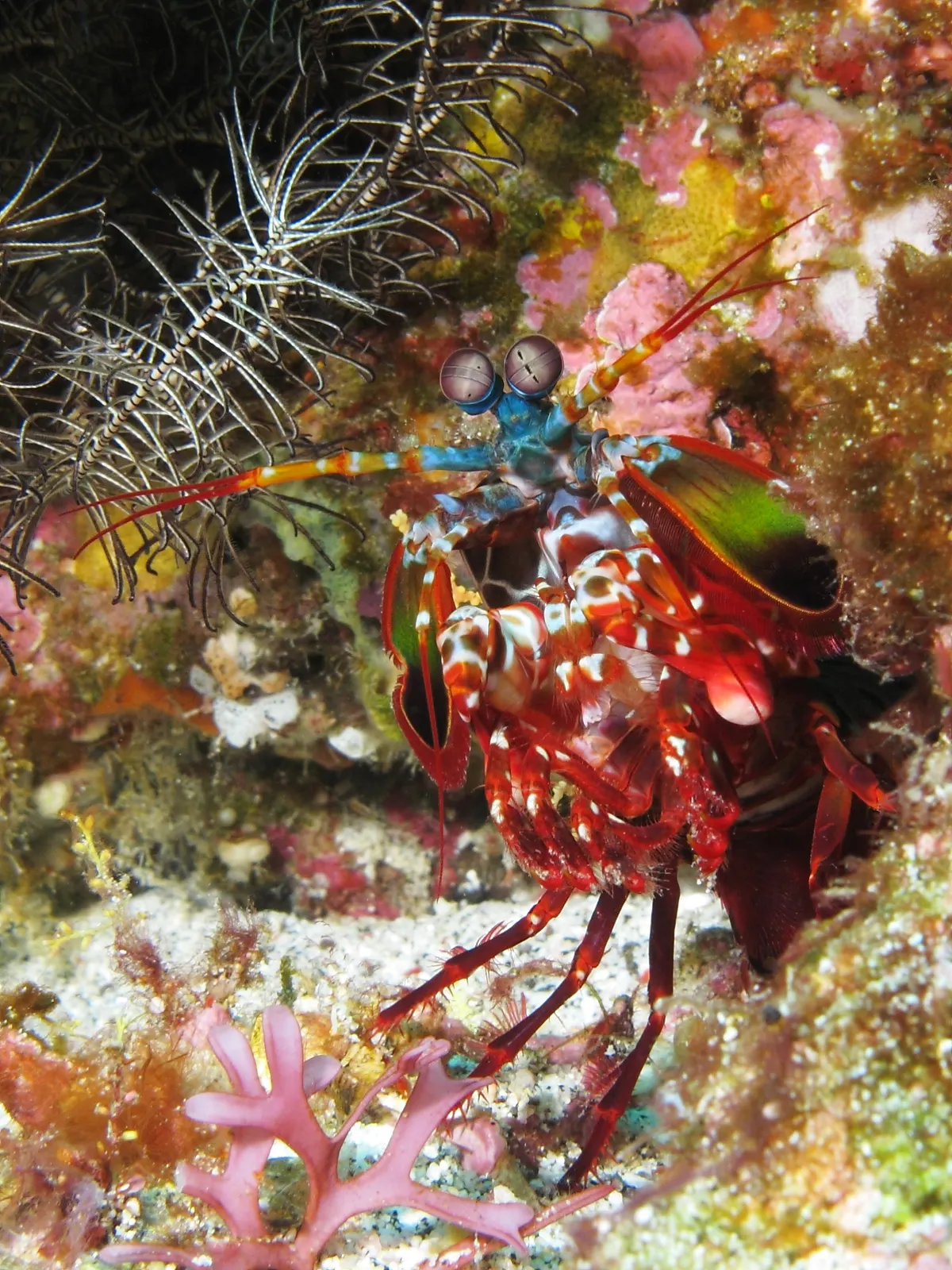
The striking clubs fold close to the body when not in use. Photo by Alexander Vasenin via Wikimedia Commons, CC BY-SA 3.0.

The strike begins with a slow energy load
Moving through water is difficult because water is dense and resists rapid acceleration. A mantis shrimp solves that problem with a biological version of a spring-loaded device.
Before a strike, large muscles contract while the limb remains latched. That contraction deforms spring-like regions of the exoskeleton, including a saddle-shaped structure visible on the appendage. Energy accumulates as elastic strain rather than immediately moving the club.
When the latch disengages, the stored energy travels through a four-bar linkage: connected rigid elements rotate together and accelerate the terminal club. This arrangement separates the relatively slow period of muscular loading from the extremely short release. Biologists call the general strategy power amplification because the output power over that brief release can exceed what the muscles could deliver directly.
The mechanism is not a single magic spring. Experiments and physical models show that its performance depends on the spring, latch, linkage geometry, and the mass and shape of the moving parts working as one system.
Why does the strike create cavitation?
As the club accelerates, pressure in the water immediately behind it can fall low enough for water vapor to form a bubble. This is cavitation—the same general phenomenon that can damage fast propellers and pumps.
The bubble survives only briefly. When surrounding pressure makes it collapse, water rushes inward and produces a second pressure pulse. In the original high-speed study, researchers measured a force peak from the club's impact followed by another associated with cavitation collapse, separated by less than a millisecond.
Cavitation adds to the event, but it should not replace the mechanical explanation. The club still makes a physical impact. Nor does the tiny, short-lived hot region inside a collapsing bubble mean that the shrimp "boils the ocean" or cooks its prey. Temperature claims about the bubble describe a microscopic event, not the temperature of the surrounding water.
Speed, force, and acceleration are different claims
Descriptions of the mantis shrimp often mix several measurements. Speed tells us how fast the club travels. Acceleration tells us how quickly it reaches that speed. Force depends on the interaction between the moving club, water, and target.
The Patek Lab's summary of measured strikes reports speeds of 12 to 23 meters per second and peak forces up to about 1,500 newtons in the studied system. Those numbers do not mean every strike by every stomatopod produces the same result. Species, body size, target, measurement position, and whether a value describes impact or cavitation all matter.
Comparing the acceleration to a bullet can make a memorable headline, but it hides the more interesting answer: a small animal uses a latch to release stored elastic energy on a timescale that muscle cannot match.
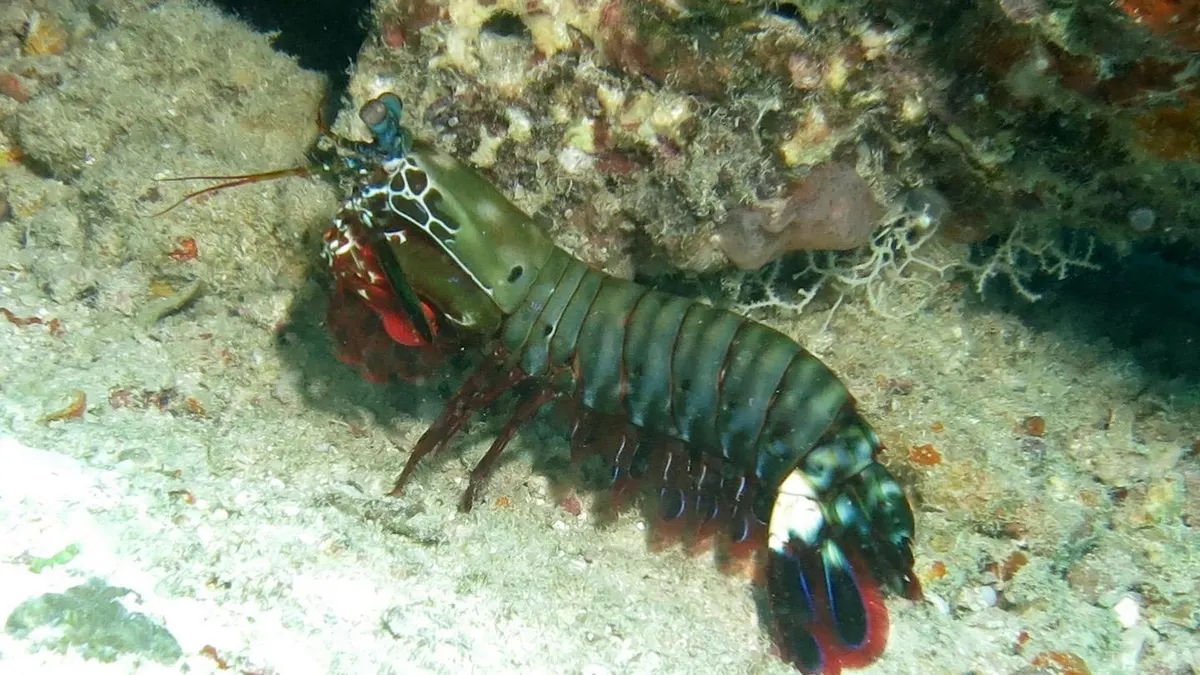
The appendages can be positioned precisely against hard prey. Photo by Jerome Paillet, IFREMER via Wikimedia Commons, CC BY 4.0.
_(Ifremer_00619-73081_-_29065).jpg)
How does the club survive repeated impacts?
The striking surface is highly mineralized, while the deeper material is arranged to resist cracks and dissipate energy. That graded construction matters because making the entire club uniformly hard would also make it brittle. A durable impact tool needs stiffness at the contact surface and damage control beneath it.
The animal also does not simply swing at maximum output without control. A smasher can vary where and how it contacts a shell, then deliver repeated blows around a vulnerable edge. The strike system is both a high-power mechanism and a feeding tool operated by a living predator.
Can a mantis shrimp break aquarium glass?
Large smashers can damage thin or vulnerable aquarium panels, and handling one carelessly can cause injury. But "it can always shatter any aquarium" is another overstatement. The result depends on the shrimp's size, the material and thickness of the panel, existing flaws, strike angle, and whether the animal repeatedly targets the same spot.
The practical conclusion is simple: do not handle a mantis shrimp, and house a large smasher only in an enclosure designed by an experienced keeper. The biological conclusion is more useful than the legend. The strike evolved to open armored prey and defend a burrow, not to demonstrate a fixed glass-breaking rating.
The short answer
A smasher mantis shrimp punches so hard because it loads an elastic exoskeletal spring, holds it with a latch, and releases the stored energy through a linkage into a reinforced club. The fast swing creates a direct impact and may also generate a cavitation pulse. Muscle supplies the energy, but the spring-and-latch system determines how quickly that energy reaches the target.
For the species' vision, habitat, diet, behavior, and conservation context, see the full peacock mantis shrimp profile.