
Animal guides
Why Do Kakapos Boom at Night?
A kakapo boom is a long-distance mating signal shaped by nocturnal life, lek breeding, and the acoustics of New Zealand forest.
By An Nguyen · Updated
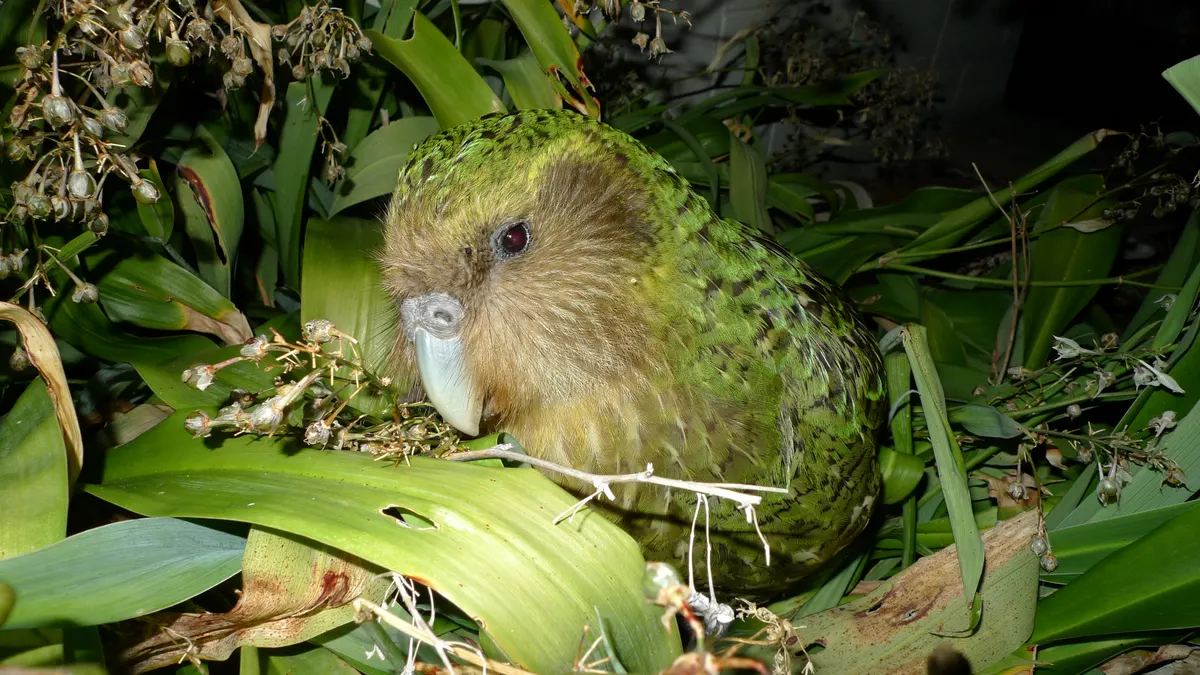
The deep boom of a male kakapo is a breeding call, not an alarm or an ordinary contact call. It travels through the forest after dark and advertises that a male is ready to mate. A second, sharper call called a “ching” helps an approaching female locate the caller more precisely.
This unusual sound makes sense when three parts of kakapo biology are considered together. Kakapos are nocturnal, they live mainly on the ground, and they use a lek mating system in which males display while females choose among them. The boom is built for that system.
Why does the call happen at night?
Kakapos normally become active after sunset, so courtship occurs on their existing schedule. Darkness also makes a loud acoustic signal more useful than a visual display across long distances. A male does not need a female to see him immediately; he first needs his call to reach her through uneven forest habitat.
Night is not silent, and vegetation can distort sound. The boom is very low and resonant, making it difficult for a listener to pinpoint. That is useful for announcing the general location of a display area, but less useful during the final approach. The higher “ching” provides a more localizable cue. The two calls therefore do different jobs rather than forming one interchangeable song.
The kakapo is not the only nocturnal New Zealand bird, but its courtship system is distinct from the ground-foraging behavior of the kiwi. A kiwi pair uses calls to maintain contact and territory. A male kakapo broadcasts from a display court and does not form a pair that raises chicks together.
What is a kakapo booming bowl?
Before calling, a male prepares a shallow depression called a bowl. He may trim vegetation around it and maintain tracks connecting several bowls on a ridge or other elevated site. The shape and position of the court can help project sound into the surrounding landscape.
At a bowl, the male inflates paired thoracic air sacs and produces repeated booming notes. New Zealand's Department of Conservation reports that a displaying male may boom every one or two seconds for as long as eight hours a night, over a period of two to three months. That is a large investment of time and energy, especially because the male provides no food or parental care afterward.
Why do males boom only in some years?
Kakapo breeding is closely associated with heavy fruiting, or “mast,” events in native trees such as rimu. These events can provide enough food for females to produce eggs and feed chicks. When food conditions and female breeding readiness align, males establish courts and compete acoustically.
This does not mean every boom produces a mating. Females visit display areas, compare males, and may leave without choosing one. After mating, the female nests and raises the young alone. The male returns to displaying, so the boom is an advertisement of the caller rather than a promise of a nest site or parental help.
Can people hear a kakapo boom?
Yes, but hearing it is not always the same as locating it. People often describe the boom as something felt as much as heard because of its low frequency. In suitable conditions it can carry for several kilometers, while local terrain and vegetation change how far it travels.
The call should not be used to approach wild kakapos without authorization. Every living kakapo is intensively managed, and breeding sites are protected. Human movement, artificial light, noise, and scent can interfere with nocturnal behavior. Recordings and conservation-program updates are the appropriate way for most people to experience the display.
The short answer
Male kakapos boom at night because a low, far-carrying call fits a nocturnal lek system. The boom attracts attention over distance; the ching helps a female close in on the correct court. Display bowls, ridge-top tracks, and repeated calling turn the surrounding forest into part of the signal.
For the species' flightlessness, diet, breeding cycle, and conservation program, see the full kakapo profile.