
Animal guides
Why Do Harpy Eagles Have Such Large Talons?
Large curved talons give a harpy eagle reach, penetration, and retention when an arboreal mammal cannot be allowed to escape.
By An Nguyen · Published · Updated
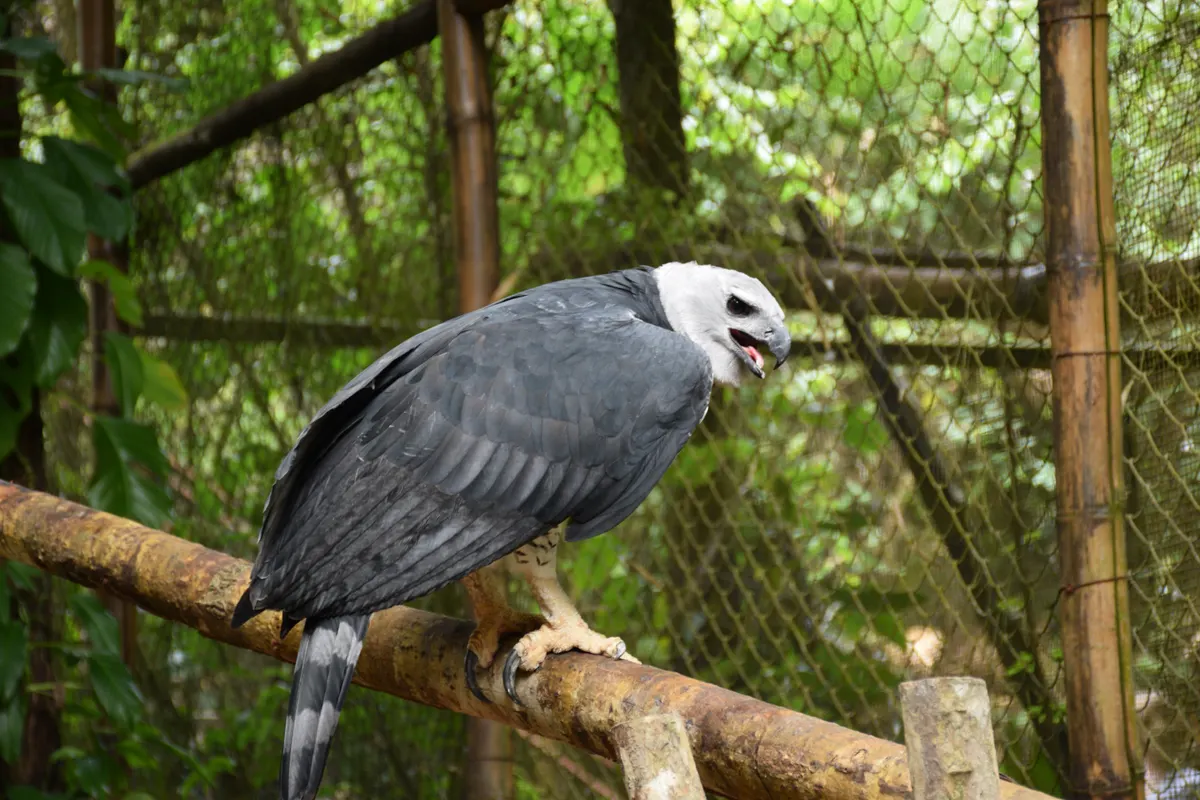
A harpy eagle's large talons are tools for catching relatively heavy prey in trees. Monkeys and sloths can twist, grip branches, and fall through dense foliage. The eagle must seize, penetrate, and retain that prey during a brief strike. Long curved claws, thick toes, and powerful foot muscles make that possible.
The rear talon can approach 13 centimeters, or about 5 inches, in a large female. That measurement describes length, not gripping pressure. Claims that every harpy eagle produces a particular number of pounds per square inch usually lack a published test and should not be treated as a standard species value.
What do the talons do during a hunt?
A harpy eagle often waits inside or near the rainforest canopy, then accelerates through a short distance when prey is exposed. Its feet extend at the end of the approach. The talons close around the animal and help prevent it from reaching another branch.
Raptor feet do not use every toe identically. Comparative research links the large inner and rear talons especially closely with retaining prey, while the other digits help encircle and control it. Curvature makes a talon better at hooking into fur and tissue than a straight claw would be.
This system suits a predator of arboreal mammals. A general eagle profile covers the wider group, but harpy eagles sit toward the heavy-prey end of that range. Their feet are proportioned for a different job from the smaller prey captured by many open-country raptors.
Why are females larger?
Female harpy eagles are substantially heavier than males and generally take larger prey. The size difference broadens the prey available to a breeding pair. A smaller male can deliver food frequently and maneuver through the canopy, while the larger female can subdue heavier animals and spends long periods at the nest during early chick care.
Larger feet scale with that larger body and prey demand. Talon size alone does not explain hunting performance: acceleration, toe closing force, leg structure, balance, and the placement of the strike all matter. The bird's short, broad wings and long tail also help it maneuver among trees rather than relying on the long glides typical of some open-country eagles.
Do the talons crush prey?
They can apply strong forces, but “crushing” is only part of the mechanism. The pointed tips concentrate force over a small area, so penetration and restraint occur together. A prey animal may be injured by the initial impact, puncture, compression, or a combination of these.
This is why pressure claims are difficult to compare. Pressure depends on contact area, which changes as a curved tip enters tissue. Grip force is also not the same as impact force. Without a standardized measurement from live birds, converting an estimate into a precise psi figure creates false certainty.
How does the rainforest shape the foot?
Harpy eagles hunt in a vertically layered forest. Prey may be above the ground and attached to branches. If a strike fails to secure it immediately, the opportunity can disappear behind leaves or into another tree.
Large, strongly curved talons reduce that risk. They provide reach around a body, sharp points for purchase, and hooks that resist escape. The tradeoff is a foot specialized for grasping rather than running. On a branch, the eagle perches and waits; the foot's critical work happens during capture and transport.
The short answer
Harpy eagles have unusually large talons because they catch large, branch-gripping mammals in a cluttered canopy. The talons function as part of a complete capture system, not as isolated weapons with one universal pressure rating.
For range, nesting, diet, and conservation status, see the full harpy eagle profile.