
Ocean life
Why Is the Coelacanth Called a Living Fossil?
The 1938 discovery made the coelacanth a symbol of deep time. Its lineage is ancient, but today's fish is neither unchanged nor a resurrected fossil species.
By An Nguyen · Published · Updated
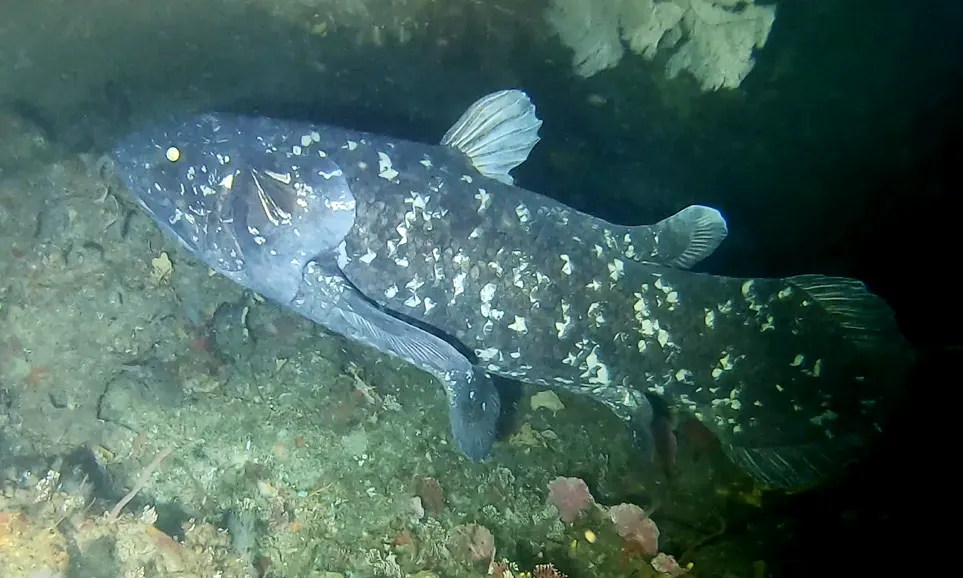
The coelacanth is called a "living fossil" because it belongs to an ancient fish lineage, resembles fossil relatives in several conspicuous features, and returned to scientific view after paleontologists thought the group had disappeared near the end of the Cretaceous Period.
But the phrase is shorthand, not a literal description. The coelacanth caught in 1938 was a living member of a newly described species, not the same species found in rocks hundreds of millions of years old. Its lineage continued evolving even when people had not yet found its recent fossils or living populations.
What happened in 1938?
On December 22, 1938, museum curator Marjorie Courtenay-Latimer examined an unusual fish landed by a trawler near East London, South Africa. Its thick scales, three-lobed tail, and fleshy paired fins did not match an ordinary local catch. Ichthyologist J. L. B. Smith later identified it as a coelacanth and described the species as Latimeria chalumnae.
The discovery was startling because coelacanths were then known from fossils, with no confirmed record younger than roughly 66 million years. Finding a living one did not bring an extinct fossil species back to life. It revealed that one surviving branch of the broader coelacanth lineage had escaped scientific detection in deep marine habitat.
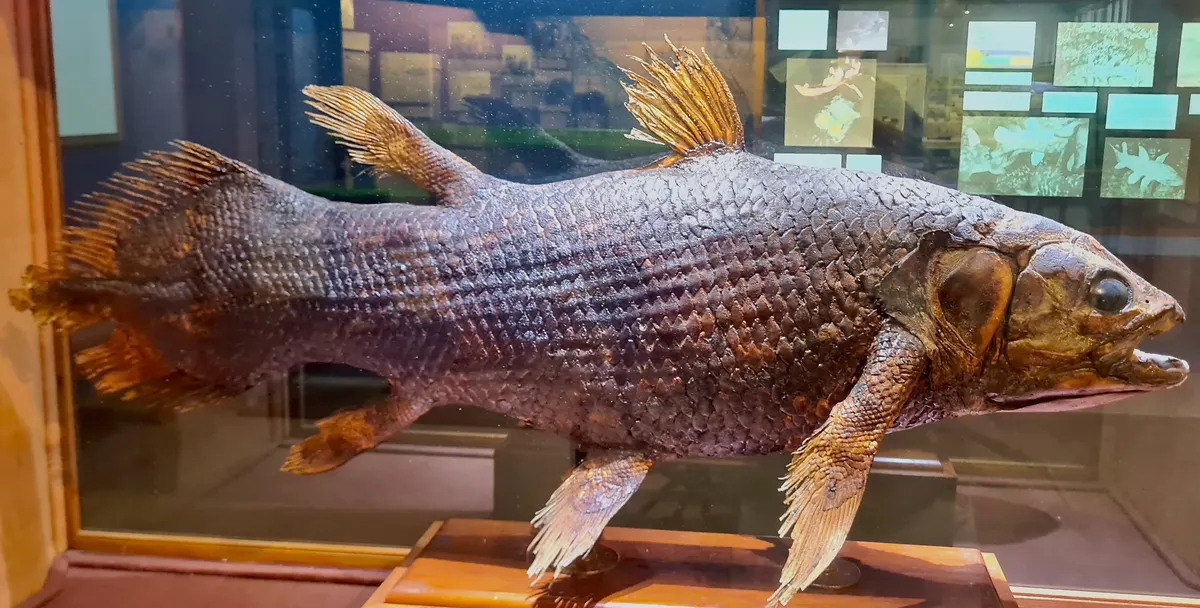
The 1938 specimen became the holotype used to define Latimeria chalumnae. Photo by Bernard DUPONT via Wikimedia Commons, CC BY-SA 2.0.
_holotype.jpg)
An ancient lineage is not an ancient individual
Coelacanth relatives appear in a fossil record extending back more than 400 million years. Over that span, the group included many body forms, habitats, and sizes. Most of those branches ended. Only two living species are recognized today: the West Indian Ocean coelacanth, Latimeria chalumnae, and the Indonesian coelacanth, Latimeria menadoensis.
This is the first problem with the living-fossil label. It compresses a once-diverse evolutionary tree into one generalized image. A modern Latimeria is no more a Devonian fossil brought forward unchanged than a modern bird is a dinosaur fossil that began moving again.
The second problem is time scale. Every coelacanth alive today has parents, developmental changes, genetic variation, and a recent ecological history. The lineage is old; the individual fish is not.
Which features look ancient?
Living coelacanths retain paired fins built around fleshy lobes rather than the thin fin rays familiar from most bony fish. They also have a three-lobed tail, a persistent fluid-filled notochord in place of a typical bony vertebral column, and an intracranial joint that allows part of the skull to flex during feeding.
Some of these features can be compared with extinct coelacanths, which explains why the 1938 specimen was recognizable. Yet resemblance does not mean anatomical identity. Fossil coelacanths varied considerably, and modern Latimeria has its own specialized deep-water biology.
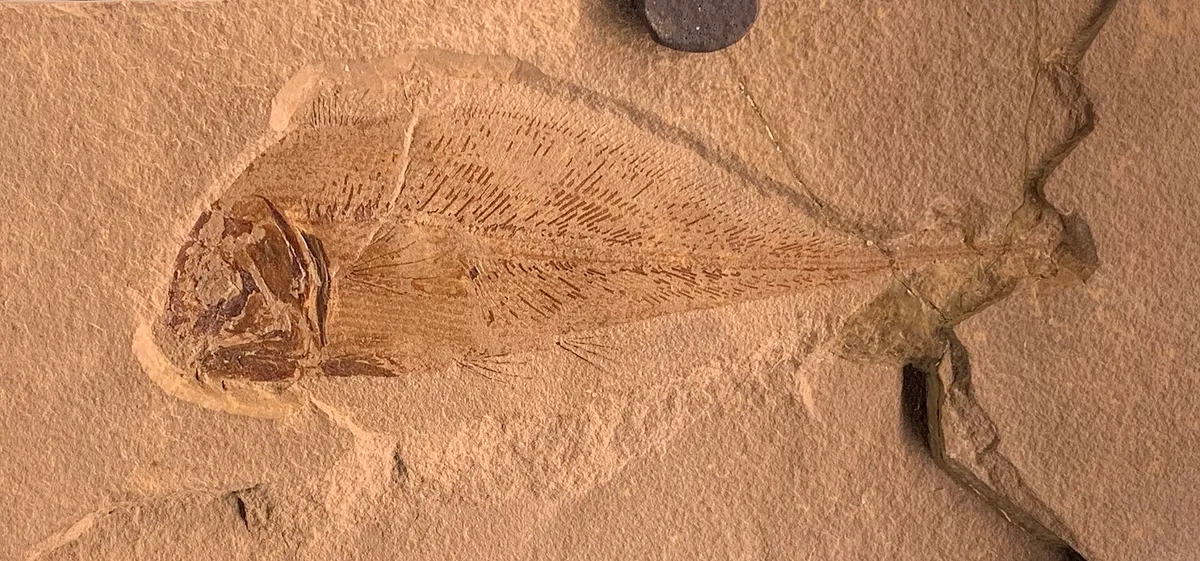
This fossil Allenypterus montanus shows one extinct coelacanth form rather than a direct specimen of the living genus. Photo by Bloopityboop via Wikimedia Commons, CC BY-SA 4.0.
.jpg)
Has the coelacanth stopped evolving?
No. A widely discussed 2013 genome study found that protein-coding genes in the coelacanth lineage had changed more slowly than the comparable genes examined in several land-vertebrate lineages. That result gave a genetic basis to the impression of slow change, but it did not show that the entire genome was frozen.
The same study cautioned that other parts of the genome did not fit a simple no-change story. Genes can evolve at different rates, body shape can appear conservative while physiology changes, and a lineage can retain old-looking traits while adapting to its present environment.
Fossil research adds another correction. A 2024 analysis of coelacanth evolution described a history with pulses of morphological change rather than one flat line of stability. Evolutionary rates can slow and accelerate as environments and lineages change.
Is the coelacanth our ancestor?
Coelacanths and land vertebrates both belong to the lobe-finned vertebrate branch, so the fish is important for understanding deep evolutionary relationships. Its paired fins are useful for studying structures shared across that larger group.
However, a living coelacanth is not a direct ancestor of amphibians, reptiles, birds, mammals, or humans. Modern coelacanths occupy a surviving side branch. Genetic evidence also shows that lungfish, not coelacanths, are the closest living fish relatives of tetrapods.
Calling the animal a "missing link" causes the same problem as calling it unchanged: it replaces a branching evolutionary tree with a ladder that has modern humans at the top.
Why do scientists still use the phrase?
"Living fossil" remains useful when it opens a conversation about a lineage known mostly from deep time, a strikingly conservative body plan, or a rediscovery after a major fossil gap. It becomes misleading when used as a scientific conclusion on its own.
A better summary is that Latimeria is the surviving representative of an ancient and formerly diverse lineage. It preserves traits that make comparison with fossils unusually informative, while its genes, populations, and deep-water adaptations show that evolution never stopped.
The short answer
The coelacanth is called a "living fossil" because it belongs to an ancient fish lineage, resembles fossil relatives in several conspicuous features, and reappeared in scientific view after paleontologists thought the group had vanished near the end of the Cretaceous. The phrase is useful shorthand, not proof that the animal stopped evolving or that a modern coelacanth is identical to a Devonian fossil.
For the living species' size, habitat, feeding, reproduction, and conservation status, see the full coelacanth profile.