
Animal guides
Why Do Frilled Lizards Open Their Frills?
The famous neck frill is not always open—and field research shows that its real jobs are more specific than most myths suggest.
By An Nguyen · Updated
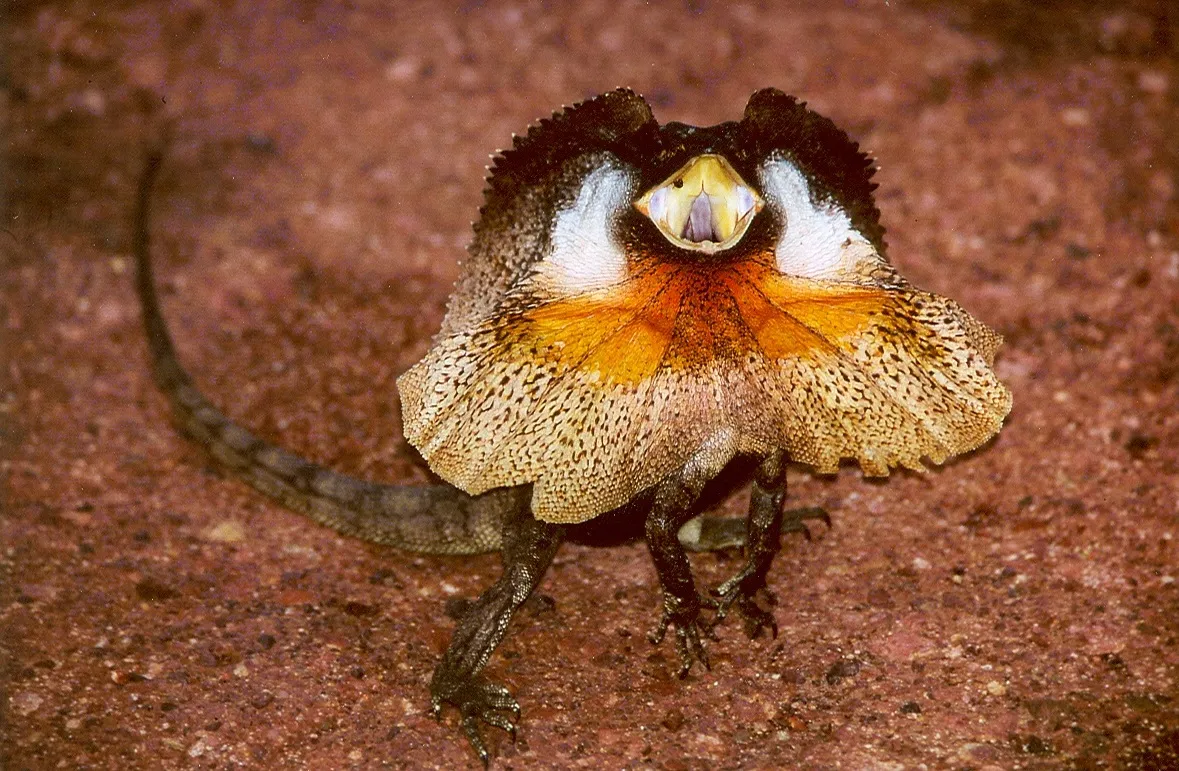
A frilled lizard does not hold its famous neck frill open all day. Most of the time, the animal rests upright on a tree trunk with the thin skin folded along its neck and shoulders. The sudden transformation happens when a visual signal is worth the effort.
The short answer is that frilled lizards open their frills for two well-supported reasons: to deter a possible predator and to communicate with other frilled lizards. The display makes a narrow, camouflaged lizard look broader, exposes contrasting colors, and draws attention to an open mouth. It is a warning, not evidence that the lizard is venomous or preparing to spit.
What makes the frill open?
The frill is a sheet of skin with a left and right lobe, not a rigid collar. Elongated supports connected to the hyoid apparatus in the throat hold it in place. When the lizard opens its jaws and moves this apparatus, the supports rotate forward and the folded skin spreads around the head.
Each lobe has three prominent ridges. A 2019 developmental study found that these regular folds emerge as the growing frill skin is constrained by nearby tissues. The process is similar to a flat sheet buckling into a predictable pattern. Those pleats let a relatively large display surface pack closely against the body when it is not being used.
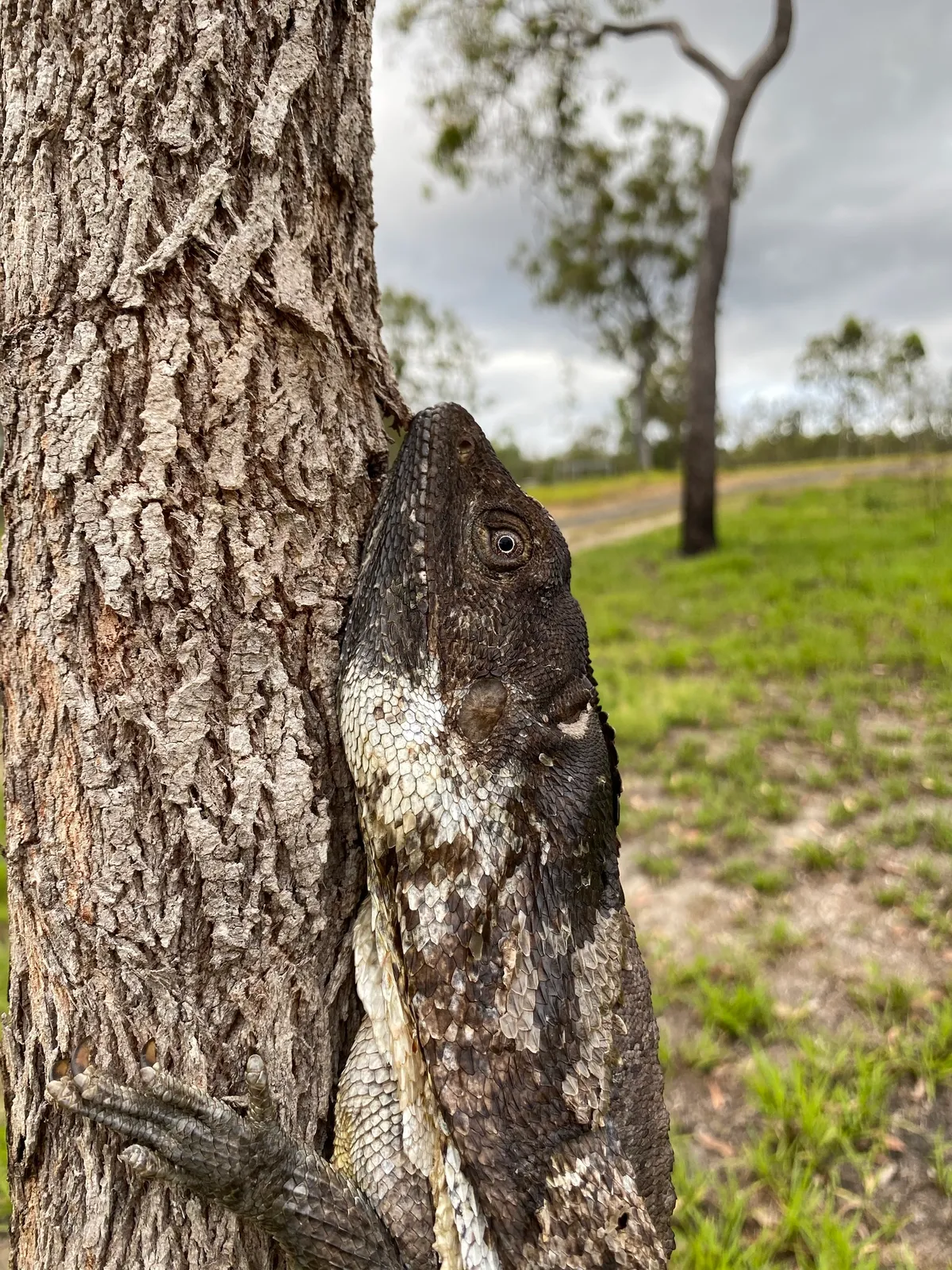
With the frill folded, the lizard's scales and narrow outline blend with the tree. Photo by Edward Bell via Wikimedia Commons, CC BY 4.0.

A threat display is more than a big collar
Opening the frill is usually part of a larger sequence. A challenged lizard may turn to face the threat, raise the front of its body, gape, spread the frill, and sometimes hiss. These actions combine size, color, posture, and movement into a display that is difficult to ignore.
That does not mean the lizard wants a physical fight. A visual warning can create a moment of hesitation, giving the animal time to turn and run toward a tree. Frilled lizards can sprint on their hind legs in short bursts, then use their claws to climb. If camouflage fails, display and escape are successive options.
The response also depends on distance and context. An undisturbed lizard may remain still against bark. One with an open route may flee without a full display. A cornered individual is more likely to stand its ground, and it can bite or scratch if handled. The frill therefore should not be read as a reliable “attack is next” signal.
Field observations settled the main question
Many explanations have been proposed for such an unusual structure. The strongest test came from researcher Richard Shine, who combined museum measurements with more than 300 hours of observations of free-ranging lizards. The study of frill function identified predator deterrence and communication within the species as its primary uses.
Both females and males erected their frills in response to potential predators and during social encounters. Males displayed frequently during the mating season, using partial frill erection together with head movements, forelimb waves, and tail lashes. That matters because the everyday question—“Why do they open the frill when frightened?”—captures only one part of the behavior.
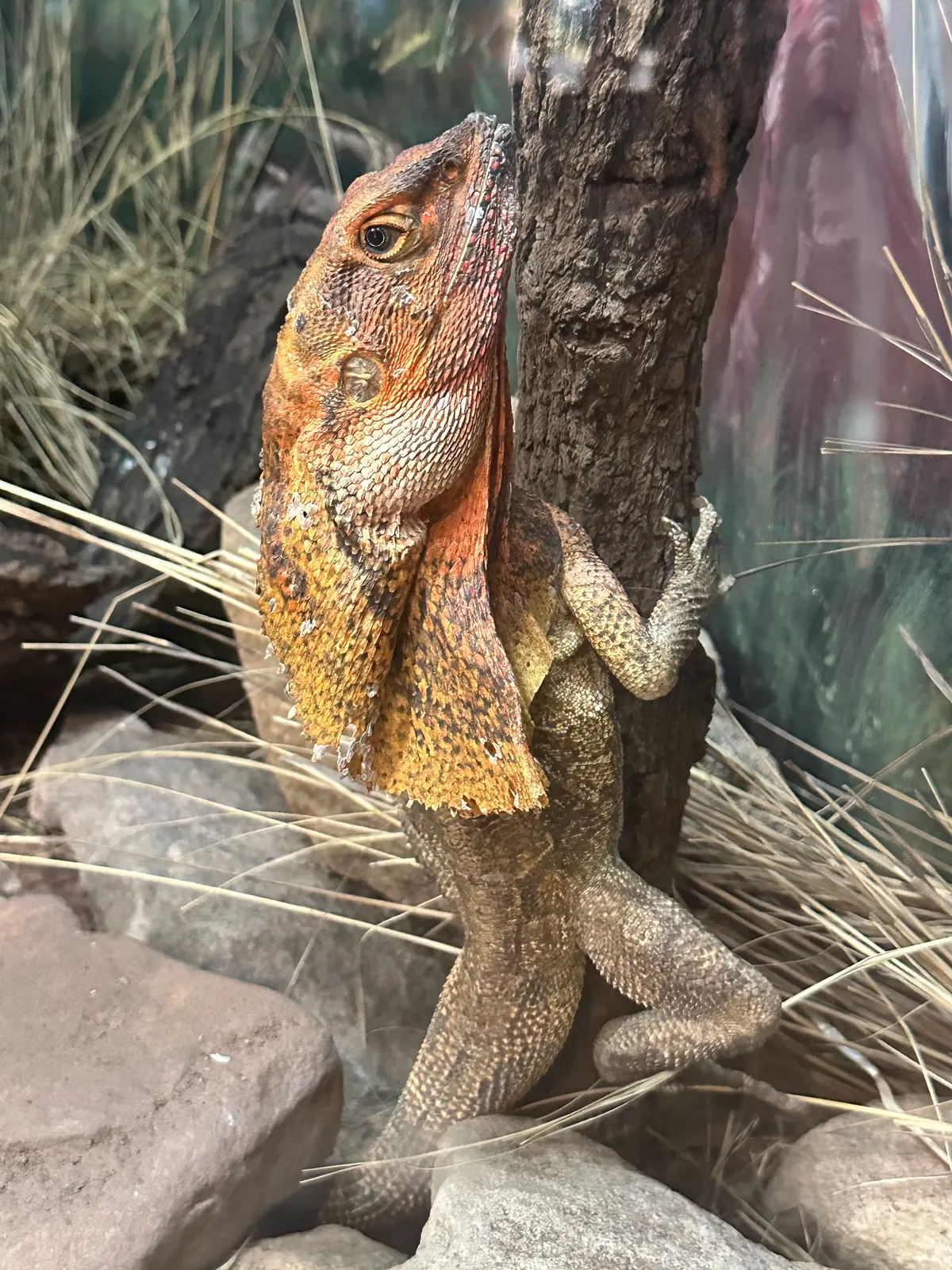
A side view shows how far the display projects beyond the head. Photo by Richard N Horne via Wikimedia Commons, CC BY 4.0.
.jpg)
Is the frill mainly for attracting mates?
Social and breeding-season displays make sexual selection a reasonable part of the story, but “males have the biggest frills to attract females” is too simple. Males grow larger than females and have larger heads at the same body size. However, field measurements did not find an equivalent difference in frill size relative to the head or body.
A later range-wide study of 279 lizards reached a compatible result: it found male-biased differences in maximum body and head size, but not in proportional frill size. Frill color also varies geographically across northern Australia, shifting broadly among red, orange, yellow, and pale forms. The display can carry information during a contest without being a simple badge that is larger on every male.
What the frill probably does not do
The field evidence did not support several older ideas. The frill is not known to be a gliding surface, a place to store food, or a primary organ for controlling body temperature. An acoustic experiment has tested whether it changes sound around the ears, but that does not overturn the behavioral evidence for its main roles.
The folded frill may incidentally add to the irregular, bark-like outline of a resting lizard. Researchers have treated that as a possible side effect rather than the reason the enlarged structure evolved. It is useful to separate a feature's occasional consequence from the function repeatedly observed in the field.
The short answer
Frilled lizards open their frills to send a strong visual message. Against a predator, the display can make the lizard look larger and buy time to escape. Around another frilled lizard, partial or full erection becomes part of a social display. A compact system of supports and pleated skin allows the same structure to lie folded during ordinary life and expand rapidly when the message matters.
For the species' range, diet, bipedal running, breeding, and conservation status, see the full frilled lizard profile.