
Panthera onca / Panthera pardus
Jaguar vs Leopard
Jaguars and leopards both have rosettes, but their continents, coat details, body build, prey, and relationship with water separate them.
By An Nguyen · Updated
At a glance
Published species data from both WildlifeDB profiles, aligned trait by trait. Size metrics highlight the larger value with a relative bar.
- Scientific name
- JaguarPanthera onca
- LeopardPanthera pardus
- Classification
- JaguarMammalia · Felidae
- LeopardMammalia · Felidae
- Native range
- JaguarSouth America, North America
- LeopardAfrica, Asia
- Primary habitat
- JaguarForest
- LeopardForest
- Diet
- JaguarCarnivore
- LeopardCarnivore
- Typical food
- JaguarCapybara, Deer, Peccary, Caiman, Fish
- LeopardAntelope, Deer, Wild pig, Monkeys, Birds
- Body length
- Jaguar3.8 feet – 6 feet
- Leopard3.5 feet – 6.2 feet
- Shoulder height
- Jaguar2 feet – 2.5 feet
- Leopard2 feet – 2.5 feet
- Weight
- Jaguar100 pounds – 250 pounds
- Leopard66 pounds – 176 pounds
- Top speed
- JaguarUp to 50 mph in short bursts
- LeopardUp to 36 mph in short bursts
- Wild lifespan
- Jaguar12 to 15 years
- Leopard12 to 17 years
- Social pattern
- JaguarSolitary hunting, Ambush predator, Swimming
- LeopardSolitary living, Ambush hunting, Tree climbing
- Key adaptations
- JaguarRosette coat pattern, Powerful jaw, Compact muscular body
- LeopardSpotted camouflage, Retractable claws, Powerful jaws
- Conservation
- JaguarNear Threatened · Decreasing
- LeopardVulnerable · Decreasing
- Reproduction
- JaguarAbout 93 to 105 days; 1 to 4 cubs per litter
- LeopardAbout 90 to 105 days; Usually 2 to 4 cubs
Start with the continent
The jaguar, Panthera onca, lives in the Americas — Brazil, Bolivia, Peru, Colombia, Venezuela, Mexico, Belize, and Panama. The leopard, Panthera pardus, lives in Africa and Asia.
Their present ranges do not overlap at all, so location answers the question outright. A spotted big cat in the Amazon is a jaguar; one in an African savanna or a South Asian forest is a leopard. Everything below is for photographs with no location attached.
Spots inside the rosettes
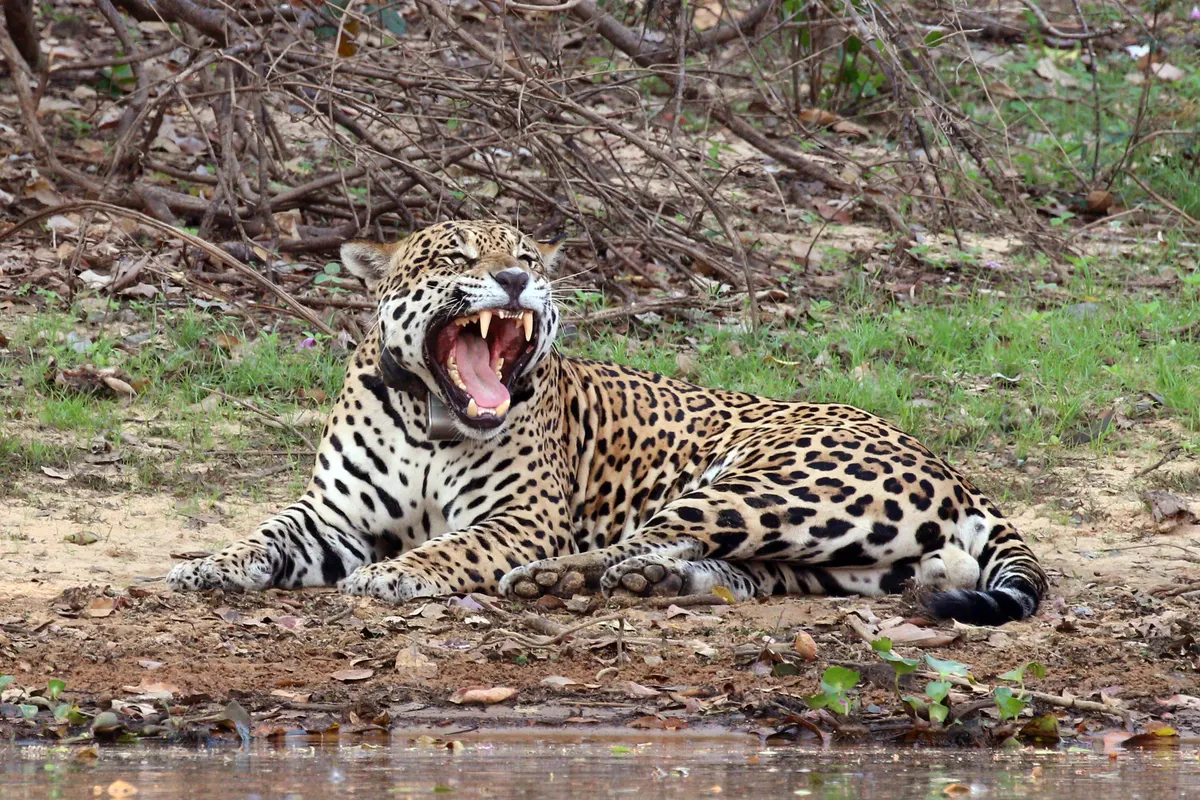
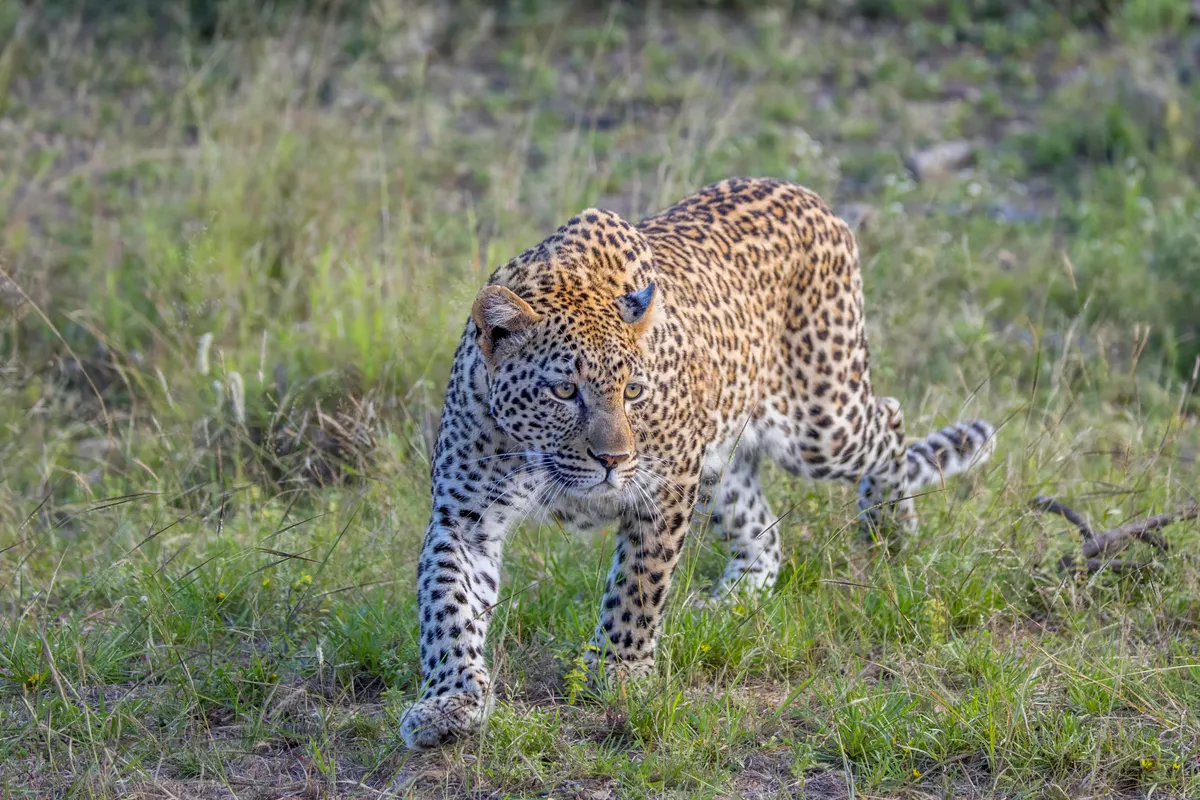
Both cats have rosettes rather than the solid spots of a cheetah. Jaguar rosettes are typically larger and usually contain one or more small dark spots inside the ring. Leopard rosettes are smaller, more densely packed, and have a more open centre.
Each animal's pattern is individual, like a fingerprint, so pattern identifies a species by its general character rather than by an exact template. Black individuals occur in both species and still carry the rosettes, visible in bright light.
Stockier build, heavier maximum
Jaguars run about 3.8–6 feet long and 100–250 pounds. Leopards run about 3.5–6.2 feet and 66–176 pounds. Lengths overlap closely; the jaguar reaches the higher maximum mass and carries it in a more compact frame.
Both profiles list a shoulder height around 2–2.5 feet, so this is not a height difference. It is a distribution-of-mass difference: jaguars look broader through chest, neck, and skull, while leopards look more lithe and long-tailed.
Speed figures deserve caution. The jaguar profile lists up to 50 mph in short bursts and the leopard up to 36 mph, but both depend on cover and a short final attack rather than open pursuit. A high top speed is useless without a close approach.
The cat that hunts caiman
Diet exposes the ecological difference behind the similar coats. Jaguar prey includes capybara, deer, peccary, caiman, fish, and turtles — aquatic and armoured animals alongside terrestrial mammals. A jaguar's bite is strong enough to pierce a turtle's shell, and it is one of the few big cats that regularly kills reptilian prey of that size. Jaguars are strong swimmers and hunt in and around rivers.
Leopards take antelope, deer, wild pig, monkeys, birds, and rodents. Camouflage, night vision, and climbing let them work forests, scrub, rocky country, and savanna. Leopards swim too, and jaguars climb, so these are tendencies rather than rules — but a stocky spotted cat swimming a tropical American river is a jaguar with high confidence.
Hauling a carcass into a tree
Leopards regularly drag prey heavier than themselves into trees, which reduces theft by lions and hyenas. It is a direct response to competition in a landscape full of larger carnivores, and it is why leopards spend so much time above ground.
Jaguars face less pressure of that kind. As the largest cat in most of their range, they have little reason to move a kill upward, and they are more likely to feed where the prey fell or near water.
Both are mainly solitary, scent-mark their ranges, and ambush rather than hunt cooperatively. Both mothers raise cubs alone; leopard cubs stay with their mother for about two years.
Both roar, and only one of them was named for it
Jaguars can roar, unlike most spotted cats. The word "jaguar" derives from a native term meaning roughly "one who kills with one leap," which describes the hunting method rather than the voice.
Near Threatened against Vulnerable
The jaguar is Near Threatened and the leopard Vulnerable, both with decreasing trends. The leopard's wider range does not make it safer: adaptability does not remove dependence on prey and cover, and local leopard populations can collapse under habitat loss and persecution while the global range still looks broad on a map.
For identification, work in order: continent first, then rosette centres, then body shape. That sequence is more reliable than any single dramatic trait.