
Panthera pardus / Acinonyx jubatus
Leopard vs Cheetah
These spotted African cats are often confused, but coat pattern, body shape, climbing ability, speed, and hunting style separate them quickly.
By An Nguyen · Updated
At a glance
Published species data from both WildlifeDB profiles, aligned trait by trait. Size metrics highlight the larger value with a relative bar.
- Scientific name
- LeopardPanthera pardus
- CheetahAcinonyx jubatus
- Classification
- LeopardMammalia · Felidae
- CheetahMammalia · Felidae
- Native range
- LeopardAfrica, Asia
- CheetahAfrica, Asia
- Primary habitat
- LeopardForest
- CheetahSavanna
- Diet
- LeopardCarnivore
- CheetahCarnivore
- Typical food
- LeopardAntelope, Deer, Wild pig, Monkeys, Birds
- CheetahGazelle, Hare, Young wildebeest, Impala, Ground birds
- Body length
- Leopard3.5 feet – 6.2 feet
- Cheetah3.5 feet – 5 feet
- Shoulder height
- Leopard2 feet – 2.5 feet
- Cheetah2.3 feet – 3 feet
- Weight
- Leopard66 pounds – 176 pounds
- Cheetah46 pounds – 160 pounds
- Top speed
- LeopardUp to 36 mph in short bursts
- CheetahUp to 60 to 70 mph in short bursts
- Wild lifespan
- Leopard12 to 17 years
- Cheetah10 to 12 years
- Social pattern
- LeopardSolitary living, Ambush hunting, Tree climbing
- CheetahDaytime hunting, Short sprint chases, Scent marking
- Key adaptations
- LeopardSpotted camouflage, Retractable claws, Powerful jaws
- CheetahLightweight body, Long legs, Flexible spine
- Conservation
- LeopardVulnerable · Decreasing
- CheetahVulnerable · Decreasing
- Reproduction
- LeopardAbout 90 to 105 days; Usually 2 to 4 cubs
- CheetahAbout 3 months; Usually 3 to 5 cubs
Rosettes against solid spots
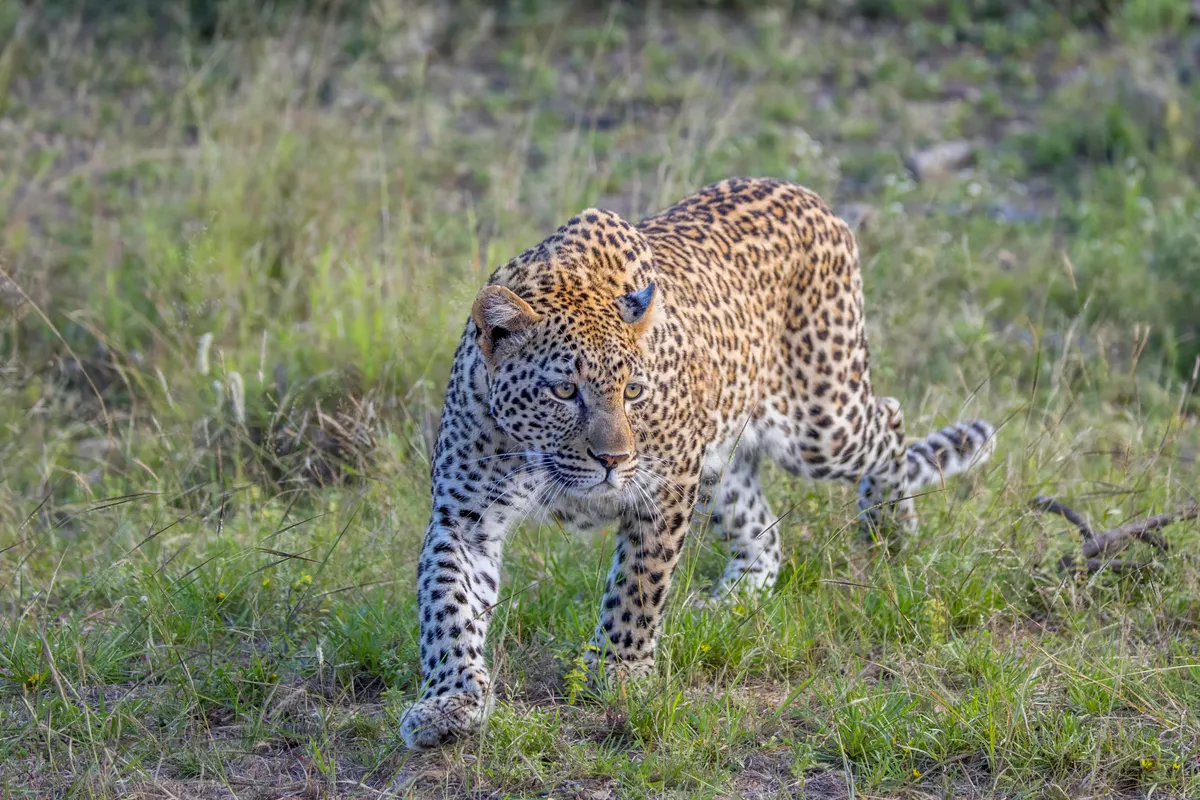
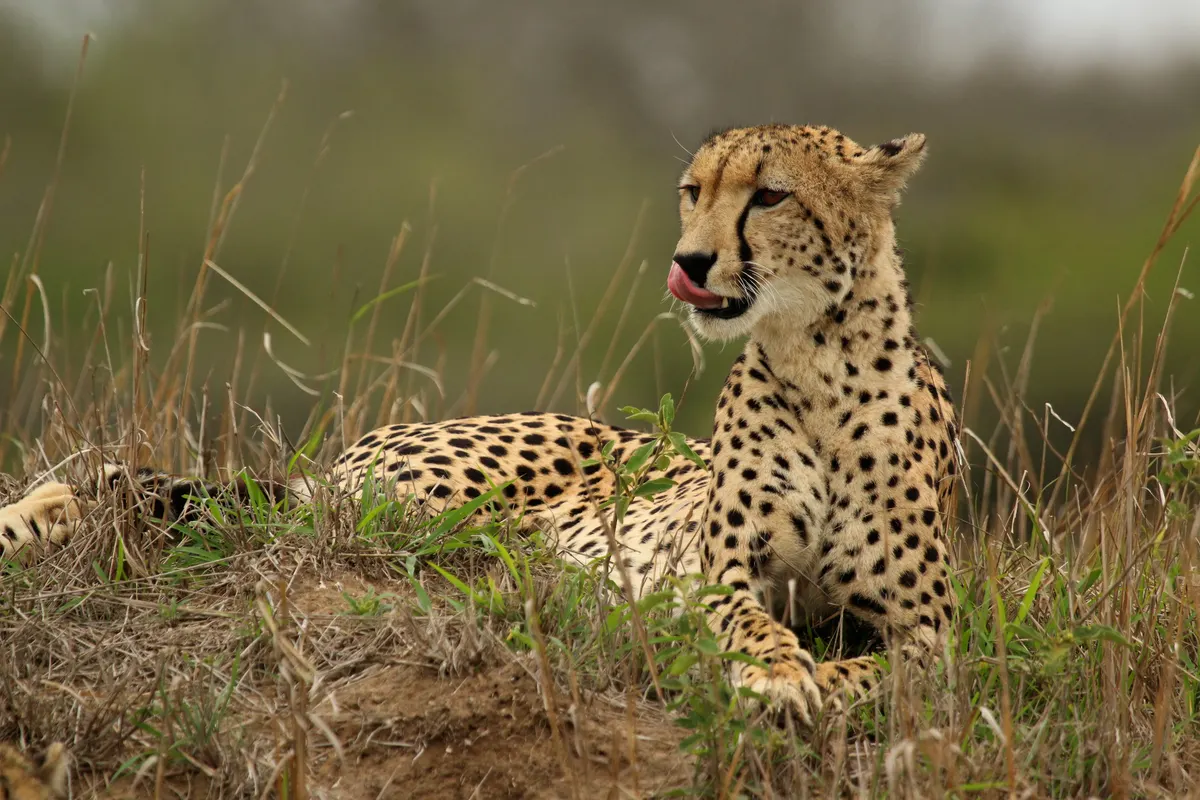
The coat is the reliable clue. The leopard has rosettes — irregular dark rings enclosing a lighter centre. The cheetah has solid round or oval spots with no ring structure at all.
This works at any distance where the pattern is resolvable, and it does not depend on judging size. Where the two ranges overlap in Africa, it is the first thing to check.
Tear marks under the eye
A cheetah has a dark "tear mark" running from the inner corner of each eye toward the mouth. A leopard does not. The marks are thought to cut glare in bright sunlight, which fits an animal that hunts in daylight.
On a head-on photograph, tear marks alone settle the identification.
Two different body plans
A leopard is compact, broad through head and shoulders, and heavily muscled. A cheetah has a small rounded head, deep chest, narrow waist, long legs, and a flexible back.
They are also not close relatives. The leopard belongs to Panthera, with lions, tigers, jaguars, and snow leopards. The cheetah is the only living species in the genus Acinonyx, so the resemblance is a matter of both being spotted African cats, not of shared ancestry.
Speed is the big number
Leopards run roughly 3.5–6.2 feet long and 66–176 pounds; cheetahs measure about 3.5–5 feet and 46–160 pounds. Lengths overlap, and an adult leopard is generally stockier with a higher maximum mass.
Speed is where the numbers diverge sharply. The cheetah profile records about 60–70 mph in short bursts and the leopard about 36 mph. The cheetah is the fastest land animal on Earth, but it cannot hold that speed for long, and the peak figure is not a travel speed — the mechanics behind the sprint depend on a spring-like spine and a very short chase.
Height inverts the size impression: cheetahs stand about 2.3–3 feet at the shoulder against roughly 2–2.5 feet for leopards. The taller animal is the lighter one.
Retractable claws against traction claws
Leopard claws retract fully, which keeps them sharp for gripping prey and climbing. Cheetah claws are only semi-retractable and work more like running spikes, giving traction during acceleration and hard turns.
The tails follow the same logic. A sprinting cheetah uses its tail as a rudder when turning at speed; a leopard's strong limbs and tail support climbing and hauling prey upward.
Ambush at night against a chase by day
Leopards often hunt at night or twilight, moving quietly through cover, scent-marking territories, and resting or caching food above ground where trees exist. Concealment does most of the work, and the final attack is short.
Cheetahs frequently hunt in daylight, when larger nocturnal predators are less active. Females usually live alone except while raising cubs, and males may be solitary or form stable coalitions, often with brothers. A coalition is a small male partnership, not a mixed group that raises young together like a lion pride.
Why a cheetah gives up its kill
Both hunt medium-sized antelope, and both are listed among each other's competitors — leopards appear in the cheetah's predator list. Cheetahs commonly take gazelles, impala, hares, ground birds, and young wildebeest, favouring prey they can overtake and control without a prolonged fight. A cheetah's light build makes injury expensive, so it will often abandon a carcass rather than contest it with a hyena or lion.
Leopards have the broader recorded diet — antelope, deer, wild pigs, monkeys, birds, and rodents — and the strength to defend a kill or move it into a tree beyond the reach of competitors. Same landscape, opposite responses to the same threat.
Open ground against broken cover
Cheetahs are tied to open grassland and savanna where they can see prey and have room to accelerate; dense cover reduces the value of their speed. Leopards use a far wider range of cover, including forest, woodland, rocky country, scrub, and savanna, across both Africa and Asia.
Habitat therefore cannot identify a distant spotted cat, because their ranges overlap where open ground meets scrub. Check rosettes versus solid spots, then the heavy build against the long-legged profile, then look for tear marks. Both species are Vulnerable with decreasing populations.