
Alligator mississippiensis / Crocodylus niloticus
Alligator vs Crocodile
A field comparison of the American alligator and Nile crocodile, including the physical clues that separate them and the limits of those shortcuts.
By An Nguyen · Updated
At a glance
Published species data from both WildlifeDB profiles, aligned trait by trait. Size metrics highlight the larger value with a relative bar.
- Scientific name
- American AlligatorAlligator mississippiensis
- Nile CrocodileCrocodylus niloticus
- Classification
- American AlligatorReptilia · Alligatoridae
- Nile CrocodileReptilia · Crocodylidae
- Native range
- American AlligatorNorth America
- Nile CrocodileAfrica
- Primary habitat
- American AlligatorWetland
- Nile CrocodileWetland
- Diet
- American AlligatorCarnivore
- Nile CrocodileCarnivore
- Typical food
- American AlligatorFish, Turtles, Birds, Mammals, Snakes
- Nile CrocodileFish, Birds, Mammals, Reptiles, Carrion
- Body length
- American Alligator8 feet – 13 feet
- Nile Crocodile11 feet – 16 feet
- Shoulder height
- American Alligator1 foot – 2 feet
- Nile Crocodile—
- Weight
- American Alligator200 pounds – 800 pounds
- Nile Crocodile500 pounds – 1,650 pounds
- Top speed
- American AlligatorExplosive lunges in water; short bursts of running on land
- Nile CrocodileFast lunges from water; strong swimmer
- Wild lifespan
- American AlligatorAbout 35 to 50 years
- Nile Crocodile50 to 70 years
- Social pattern
- American AlligatorAmbush hunting, Basking, Alligator hole digging
- Nile CrocodileAmbush hunting, Basking, Nest guarding
- Key adaptations
- American AlligatorBroad U-shaped snout, Osteoderm armor, Nictitating membrane
- Nile CrocodilePowerful jaws, Armored scales, Nostrils on snout top
- Conservation
- American AlligatorLeast Concern · Stable
- Nile CrocodileLeast Concern · Stable
- Reproduction
- American AlligatorAbout 65 days of nest incubation; Usually 20 to 50 eggs per nest
- Nile CrocodileEggs incubate about 3 months in nests; Usually 25 to 80 eggs
The two field marks that actually work
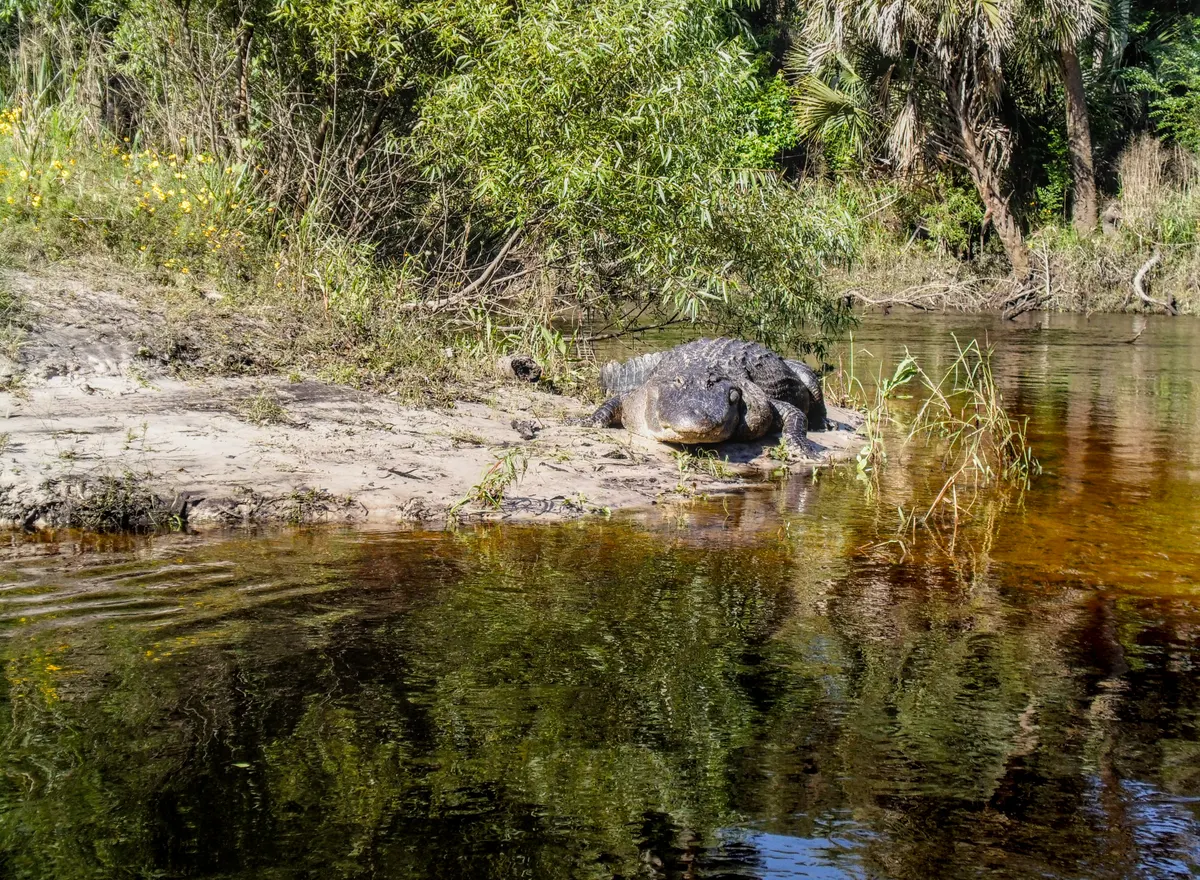
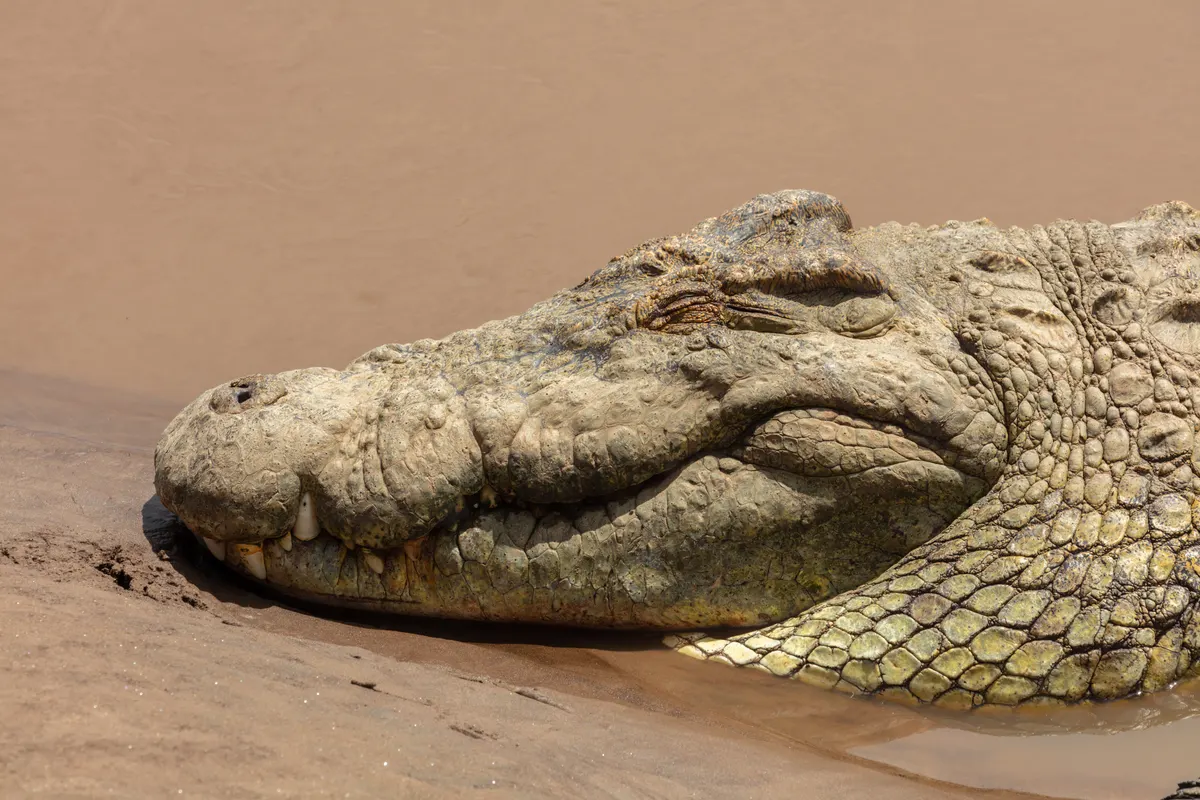
Look at the head and the closed jaw. An American alligator usually has a broad, rounded, U-shaped snout. A Nile crocodile has a narrower, more tapered snout. With the mouth shut, an alligator's lower teeth sit mostly hidden inside the upper jaw, while on a crocodile the enlarged fourth tooth of the lower jaw commonly stays visible.
Those two clues together are more reliable than either one alone, and both can be checked from a photograph without any measurement.
Where the shortcuts break down
Neither mark is a universal key to the order Crocodilia. Snout proportions vary between species and change with age, and there are broad-snouted crocodiles and narrow-snouted alligator relatives.
Location does most of the work. A large crocodilian in the southeastern United States is very likely an American alligator; the Nile crocodile record used here is African. Combining range with head shape resolves nearly every real sighting, and the gharial comparison shows how far snout shape can diverge inside the same order.
Overlapping length, different maximum weight
American alligators reach roughly 8–13 feet and 200–800 pounds. Nile crocodiles span about 11–16 feet and 500–1,650 pounds. The length ranges overlap, but a large adult Nile crocodile can be about twice the mass of the alligator compared here.
Length estimates alone are weak evidence in the field. Distance, water distortion, and how much of the animal sits above the surface all distort the apparent size of a crocodilian. Head shape, visible teeth, and known range beat a guessed measurement.
One ambush pattern, two hunting grounds
Both are armored, semi-aquatic ambush predators. Eyes and nostrils sit high on the head so the rest of the body can stay submerged, a muscular tail supplies swimming power, and both can launch a short, fast attack from the water's edge. Neither chases prey over distance: the strategy is to stay hard to see, close the last gap quickly, seize with the jaws, and use the water or a rolling motion to subdue food.
Prey overlaps because both are opportunistic carnivores. Alligators eat fish, turtles, snakes, birds, mammals, amphibians, and crustaceans; Nile crocodiles take fish, birds, reptiles, mammals, and carrion. In both species juveniles depend far more on insects and small fish, so diet shifts with body size rather than being fixed by species.
Digging a wetland against patrolling a river
American alligators reshape their habitat. They dig and maintain "alligator holes" that hold water through dry periods, which then support fish, turtles, and wading birds — a straightforward example of a species engineering its own wetland. Females build vegetation nests, stay near them, and may carry hatchlings to water in their mouths.
Nile crocodiles patrol rivers, lakes, and marsh edges, and several animals may bask together or gather near concentrated food. That is aggregation, not a cooperative social group in the sense of a lion pride. Females of both species guard nests, and adults of both communicate with low-frequency calls, splashes, and body postures.
Nest temperature decides sex in both
Neither species has sex chromosomes that determine the outcome at fertilisation. In both, the temperature inside the nest during incubation influences whether eggs hatch as males or females. Alligator eggs incubate about 65 days; Nile crocodile eggs take roughly three months. A nest built in the wrong place, or a season that runs unusually warm or cool, can therefore skew a whole clutch.
Freshwater marsh against African river
The American alligator is a North American freshwater animal, tied to marshes, swamps, ponds, slow rivers, and lakes. It tolerates some brackish water but lacks the crocodile's more effective salt-excreting glands, so extended time in saline water suits it poorly.
The Nile crocodile occupies rivers, lakes, marshes, and seasonal waters across much of Africa. Both need basking and nesting sites, but geography separates these two records far more decisively than any habitat label.
Why "Least Concern" hides local problems
Both species are Least Concern with stable overall trends in this dataset. That global category says nothing about a particular river. Wetland drainage, illegal killing, entanglement in fishing gear, and conflict with people still matter region by region, and a stable species can contain declining populations.