
Canis latrans / Canis lupus
Coyote vs Wolf
Coyotes and gray wolves are related Canis species, but wolves are larger pack hunters while coyotes use more flexible social groups and a broader diet.
By An Nguyen · Updated
At a glance
Published species data from both WildlifeDB profiles, aligned trait by trait. Size metrics highlight the larger value with a relative bar.
- Scientific name
- CoyoteCanis latrans
- WolfCanis lupus
- Classification
- CoyoteMammalia · Canidae
- WolfMammalia · Canidae
- Native range
- CoyoteNorth America
- WolfNorth America, Europe, Asia
- Primary habitat
- CoyoteGrassland
- WolfForest
- Diet
- CoyoteCarnivore
- WolfCarnivore
- Typical food
- CoyoteRodents, Rabbits, Hares, Birds, Insects
- WolfDeer, Elk, Moose, Bison, Caribou
- Body length
- Coyote30 inches – 40 inches
- Wolf3.5 feet – 6.5 feet
- Shoulder height
- Coyote18 inches – 24 inches
- Wolf2 feet – 3 feet
- Weight
- Coyote20 pounds – 50 pounds
- Wolf50 pounds – 175 pounds
- Top speed
- CoyoteUp to about 40 mph in short bursts
- WolfUp to 37 mph in short chases
- Wild lifespan
- CoyoteAbout 10 to 14 years
- Wolf6 to 8 years
- Social pattern
- CoyoteHowling and yipping, Nocturnal hunting, Pair bonding
- WolfPack living, Cooperative hunting, Howling
- Key adaptations
- CoyoteFlexible diet, Urban tolerance, Keen hearing and smell
- WolfKeen sense of smell, Endurance running, Strong jaws
- Conservation
- CoyoteLeast Concern · Increasing
- WolfLeast Concern · Stable
- Reproduction
- CoyoteAbout 60 to 63 days; Usually 4 to 7 pups per litter
- WolfAbout 63 days; Usually 4 to 6 pups
A coyote is not a young wolf
The coyote, Canis latrans, and the gray wolf, Canis lupus, share a genus and are separate species. A coyote is not an immature or underfed wolf, and the two are not interchangeable at any age.
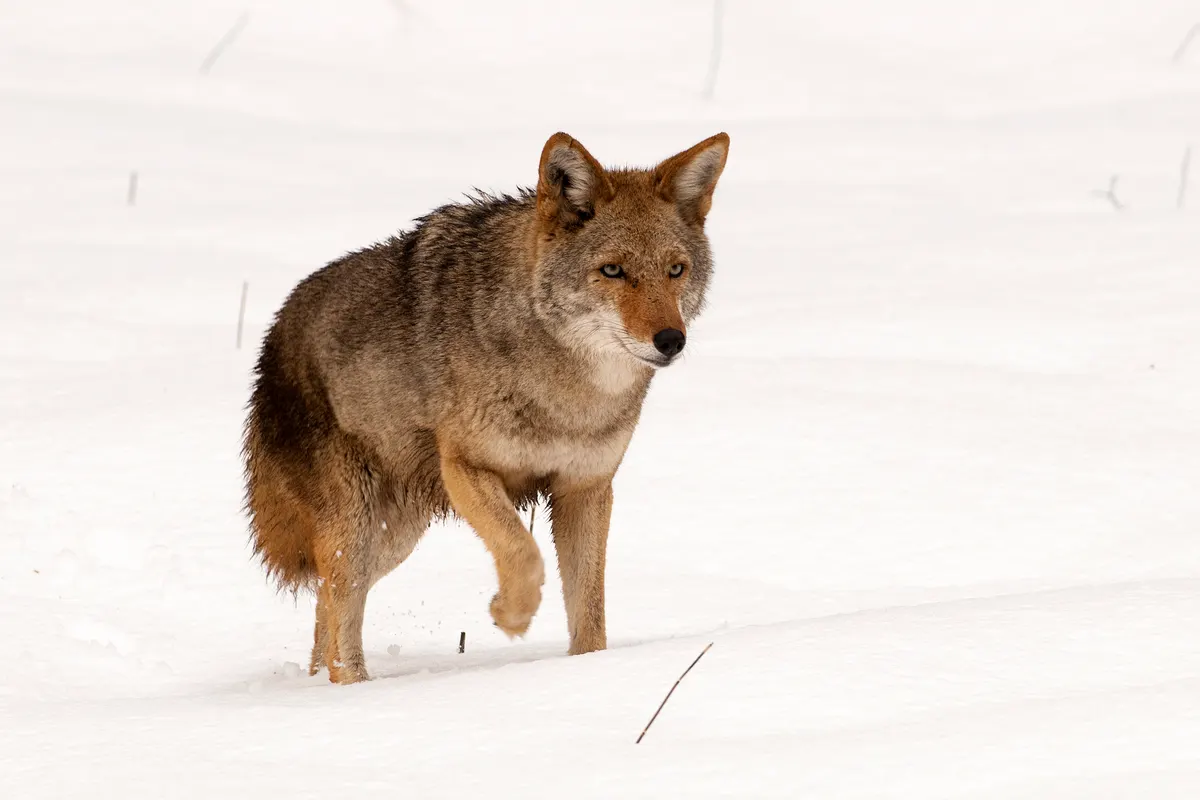
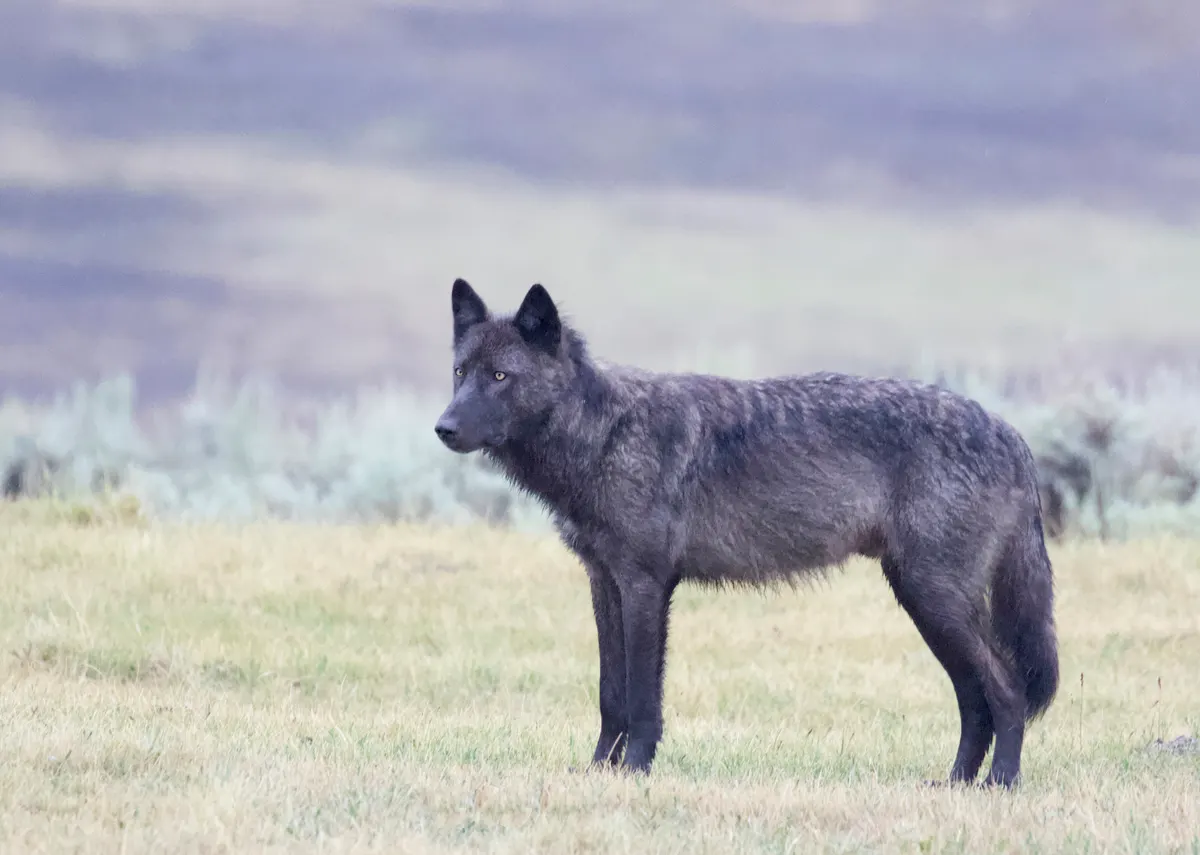
Body proportions give the clearest live clues. Coyotes have a narrow muzzle, relatively large pointed ears, small feet, and a light frame. Gray wolves have broader heads, ears that look shorter against the skull, larger paws, longer legs, and a deep chest. Coat colour overlaps almost completely across both species, so grey, brown, reddish, black, or pale fur identifies neither.
Weight is the number that separates them
Coyotes measure about 30–40 inches in body length, stand 18–24 inches at the shoulder, and weigh roughly 20–50 pounds. Gray wolves run about 3.5–6.5 feet from nose to tail, stand 2–3 feet at the shoulder, and weigh about 50–175 pounds.
The top of the coyote range meets the bottom of the wolf range, so weight is decisive only in the middle. Most adult wolves are visibly taller and heavier. Regional variation muddies quick calls: northern coyotes can be larger and thicker-furred than desert animals, and wolf size also differs sharply between populations.
Reading tracks when the animal is gone
Tracks often resolve a sighting that the eye could not. Wolf prints are generally larger and more elongated, with a travel pattern suited to long, direct movement. Coyote tracks are smaller and narrower.
The complication is domestic dogs, whose tracks can overlap both. A single print without a scale reference or a stretch of trail pattern is weak evidence for any of the three.
Rodents against elk
Prey size is the major ecological difference. Gray wolves focus on deer, elk, moose, bison, caribou, and wild boar. A pack can test a herd and subdue animals far too large and dangerous for a lone canid, though wolves also take smaller prey and scavenge, and can eat up to 20 pounds of meat in a sitting after a kill.
Coyotes typically eat rodents, rabbits, hares, birds, insects, carrion, and seasonal fruit. They may take deer fawns or weakened deer, or work together on larger prey, but voles, mice, and rabbits are the characteristic foundation. A coyote's hearing can pick up rodents moving under snow or grass, which is the skill that diet depends on.
Neither species has a fixed menu. Wolf diets shift with local ungulates and pack size; coyotes respond quickly to fruit, insects, carrion, and food associated with people. Feeding either animal deliberately raises the risk of conflict.
Family packs against flexible pairs
Gray wolf society usually centres on a family pack: a breeding pair and offspring from one or more years, travelling, defending territory, raising pups, and hunting together. Cooperation is what makes large hoofed prey accessible, and participation varies with season and food supply.
Coyotes also form lasting pairs and family groups, but their sociality is looser. Parents and young may hold a territory and share pup care, while individual coyotes often forage alone for rodents. Pups may stay with their parents for up to a year before dispersing. A coyote seen alone is not necessarily without a mate or family.
Why a small group can sound like a large one
Both species howl, for different purposes. Wolves use long-distance howls to locate separated pack members, rally the family, and warn neighbouring packs; each wolf's howl is individual enough for pack members to recognise.
Coyotes mix howls with yips and barks, and a small number of animals can sound like a much larger group when overlapping calls echo across open ground. Counting animals by ear overestimates coyotes in particular, which is one reason reported "packs" near towns are often a pair and their pups.
Why coyotes expanded as wolves declined
Coyotes use grassland, prairie, forest edges, desert scrub, farmland, mountains, and suburban greenbelts, adjusting their activity to avoid people and moving through rail corridors, drainage channels, and parks. That tolerance carried them across most of North America, and they expanded into eastern regions after large wolf packs declined there.
Gray wolves occupy forest, tundra, mountains, and grassland, but need larger territories with enough wild prey and room for a family group. Persecution and fragmentation removed wolves from much of their former range even where the physical habitat still looks suitable — which is precisely the gap the coyote filled.
In shared range, look for the coyote's smaller frame, narrow face, prominent ears, and flexible solitary or pair foraging. A wolf is larger, broad-headed, long-legged, and more closely tied to a pack and to large ungulate prey. The same size logic separates a wolf from the much smaller red fox.