
Animal guides
How Do Zebra Stripes Help Them?
A zebra's stripes are not paint on a horse. They are an individual pattern shaped by life on the African plains.
By An Nguyen · Published · Updated
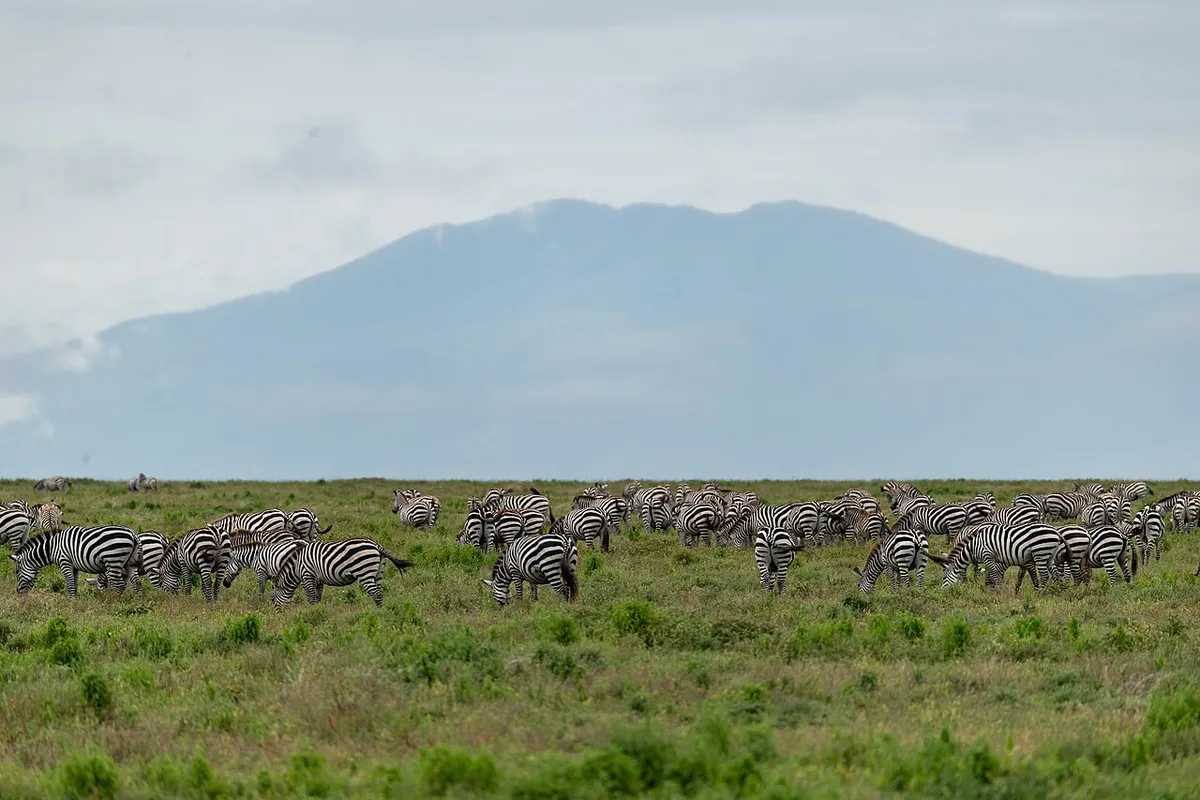
Zebra stripes are one of the clearest patterns in nature, but scientists do not treat them as decoration. The pattern is different on every animal, and it may serve several useful jobs rather than one single purpose.
That multi-function view is important. Popular explanations often pick one dramatic story—camouflage, dazzle, or temperature control—and treat it as settled. Current research is more careful: some benefits have strong support, others remain plausible but incomplete, and the mix may differ among zebra species and habitats.
A pattern that identifies an individual
No two zebras have exactly the same arrangement of black and white stripes. A foal has to keep track of its mother in a herd where many bodies are moving together, and an individual pattern can help make that possible. Smithsonian notes that stripes cover even the mane and ears of a zebra.
Recognition works at close range, where a foal or herd member can learn a familiar outline. That social job does not cancel other explanations. A pattern useful for bonding can still affect insects or predators in different situations.
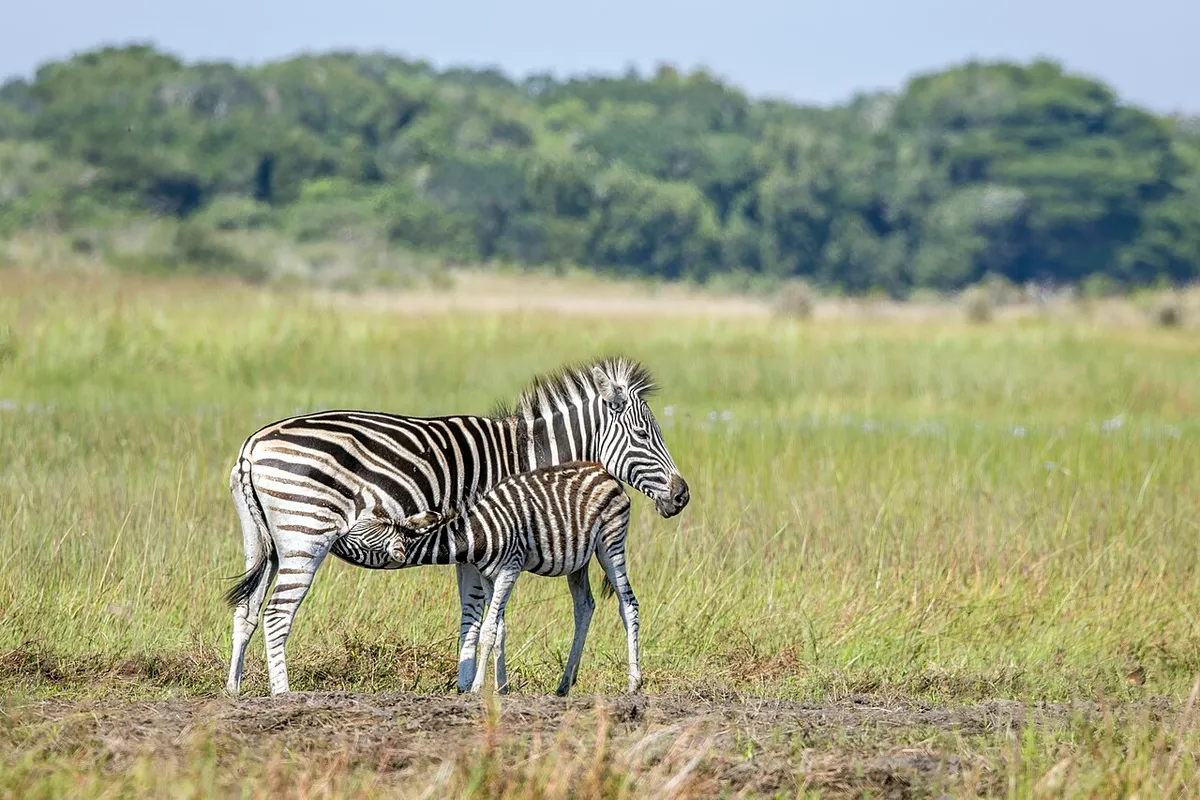
Photo by Charles J. Sharp via Wikimedia Commons, CC BY-SA 4.0.
_foal_suckling_Maputo.jpg)
Do stripes confuse predators?
When a herd runs, many narrow lines move in different directions at once. This may make it harder for a predator to choose and follow one animal, especially from a distance. It is a plausible advantage, but not the whole explanation: stripes also matter when a zebra is standing still or is seen close up.
Motion dazzle is therefore best treated as one candidate among several. Lions and other hunters succeed against zebras often enough that stripes clearly do not make the animals invisible. If the pattern helps, it likely helps at the margins—delaying a decision, breaking a silhouette, or complicating a chase in tall grass or dust.
Stripes may affect biting flies
Research has also investigated whether striped coats make it harder for biting flies to land. That idea helps explain why bold stripes could be useful in open country where insects are common. Experiments with striped surfaces and observations of horseflies suggest that high-contrast patterns can disrupt landing behaviour.
This insect-deterrence hypothesis has gained attention because it can operate even when no predator is nearby. In habitats where blood-feeding flies are abundant, reducing harassment and disease risk would be a continuous benefit. Scientists are still testing how much each benefit matters for different zebra species and habitats.
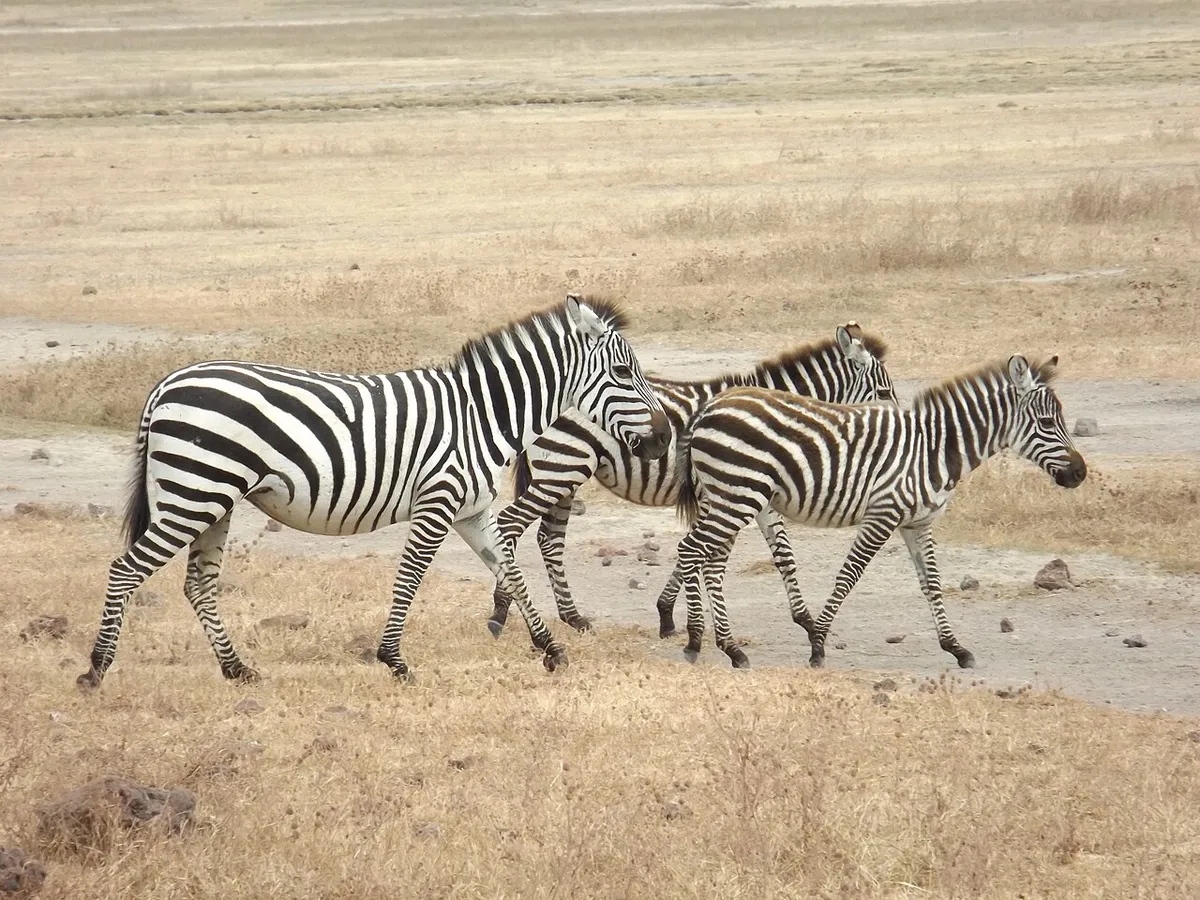
Photo by Floodmfx via Wikimedia Commons, CC BY-SA 4.0.

What about cooling and camouflage?
Thermoregulation ideas propose that black and white stripes create tiny air movements or temperature differences across the coat. Evidence for a strong cooling effect is mixed, and the claim should not be presented as proven. Camouflage ideas are similarly incomplete: stripes can break up outline in some light, yet zebras are often conspicuous in open grassland and savanna.
The honest summary is that stripes are unlikely to be a single-purpose adaptation. Recognition, insect deterrence, and predator confusion can all contribute, while temperature stories need stronger field support before they become the headline.
Why zebra species still look different
Plains, mountain, and Grevy's zebras do not wear identical patterns. Stripe width, belly coverage, and contrast vary. Those differences track ecology and evolutionary history as much as a single universal rule. A pattern that works in one landscape may be tuned differently in another.
Zebras are equids—odd-toed hoofed mammals related to horses and asses—so their striped coats sit on a body plan built for grazing and travel, not for hiding in dense forest. The coat is one layer of adaptation on top of herd behaviour, speed, and vigilance.
The short answer
Zebra stripes are unique to each animal and probably help in more than one way. Recognition, moving in a herd, and interactions with insects can all matter; a single dramatic explanation is too simple.
For species facts, range, and conservation context, see the full zebra profile.