
Panthera leo / Panthera tigris
Lion vs Tiger
A data-led comparison of two Panthera cats, focused on body size, social systems, hunting, habitat, and conservation—not a speculative fight.
By An Nguyen · Updated
At a glance
Published species data from both WildlifeDB profiles, aligned trait by trait. Size metrics highlight the larger value with a relative bar.
- Scientific name
- LionPanthera leo
- TigerPanthera tigris
- Classification
- LionMammalia · Felidae
- TigerMammalia · Felidae
- Native range
- LionAfrica, Asia
- TigerAsia
- Primary habitat
- LionSavanna
- TigerForest
- Diet
- LionCarnivore
- TigerCarnivore
- Typical food
- LionZebra, Wildebeest, Antelope, Buffalo, Warthog
- TigerDeer, Wild pig, Buffalo, Antelope, Sambar
- Body length
- Lion4.5 feet – 8 feet
- Tiger6 feet – 10 feet
- Shoulder height
- Lion3.5 feet – 4 feet
- Tiger2.5 feet – 3.5 feet
- Weight
- Lion265 pounds – 550 pounds
- Tiger220 pounds – 660 pounds
- Top speed
- LionUp to 50 mph in short bursts
- TigerUp to 40 mph in short bursts
- Wild lifespan
- Lion10 to 14 years
- Tiger10 to 15 years
- Social pattern
- LionPride living, Cooperative hunting, Territory defense
- TigerSolitary living, Ambush hunting, Scent marking
- Key adaptations
- LionNight vision, Retractable claws, Powerful jaws
- TigerStriped camouflage, Night vision, Powerful jaws
- Conservation
- LionVulnerable · Decreasing
- TigerEndangered · Decreasing
- Reproduction
- LionAbout 110 days; 2 to 4 cubs per litter
- TigerAbout 103 days; Usually 2 to 4 cubs
Prides against solitary territories
The social difference is sharper than the physical one. Lions are the only big cats that usually live in large family groups: prides made up mainly of related females, their cubs, and a coalition of males. Tigers are normally solitary, occupying individual ranges and communicating through scent marks, scratches, and calls.
Pride membership does not mean every lion hunts as part of a team. Lions also hunt alone, and the contribution of males and females varies with prey and habitat. Cooperation matters most when defending territory, protecting cubs, or handling prey one animal cannot control — the reasons lions live in prides at all.
A male tiger's range may overlap those of several females, but adults do not form a permanent group. A lioness may rear cubs alongside related females and sometimes nurse or guard young communally; a tigress raises her cubs alone until they can hunt and hold their own range. In both species, young animals face high mortality before independence.
Which cat is heavier
Lions weigh about 265–550 pounds and tigers about 220–660 pounds in the current records, so the ranges overlap and the tiger reaches the higher maximum. Sex, subspecies, age, and individual condition matter more than the species label in any single case.
Lions stand about 3.5–4 feet at the shoulder against roughly 2.5–3.5 feet for tigers, while tigers run longer overall at 6–10 feet against the lion's 4.5–8 feet. That combination — taller lion, longer and potentially heavier tiger — is exactly why one "bigger" label hides the real picture.
Mane against stripes
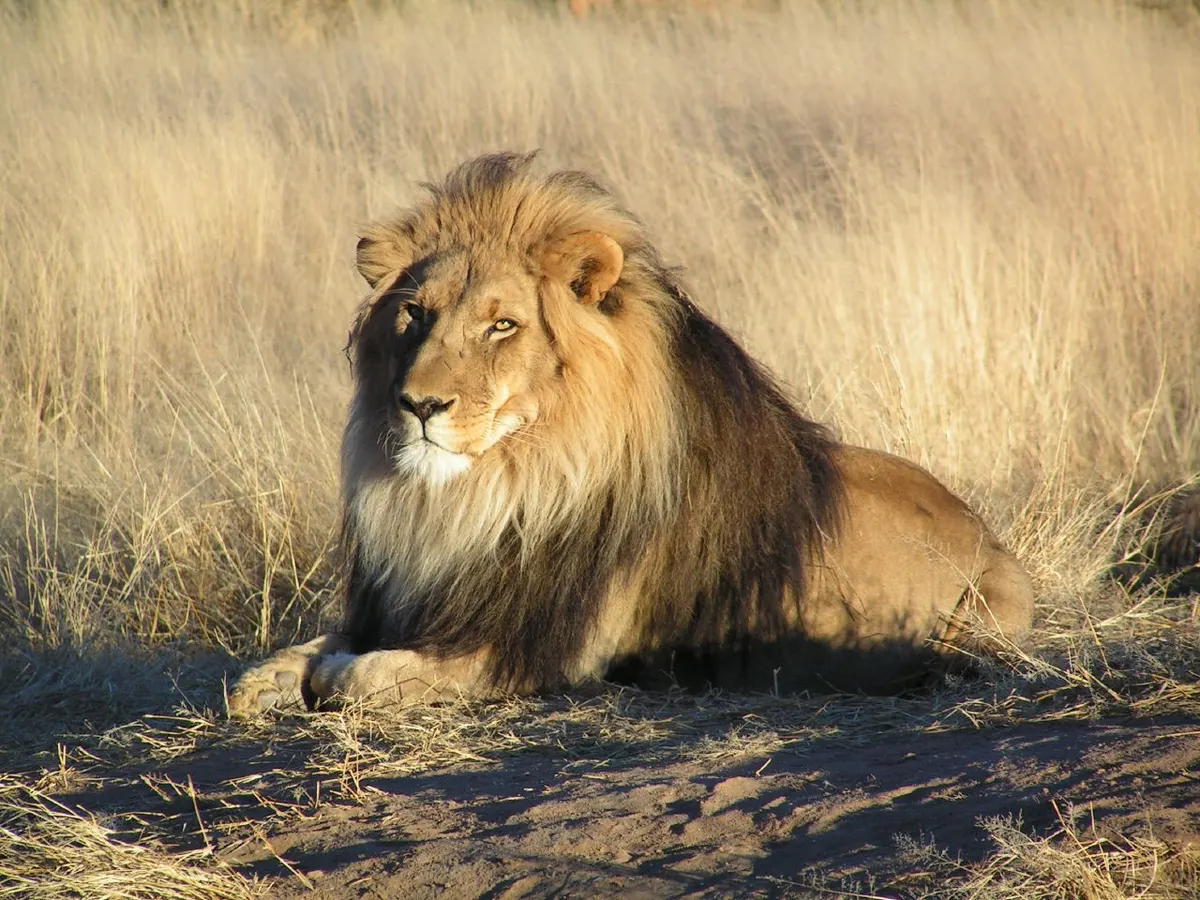
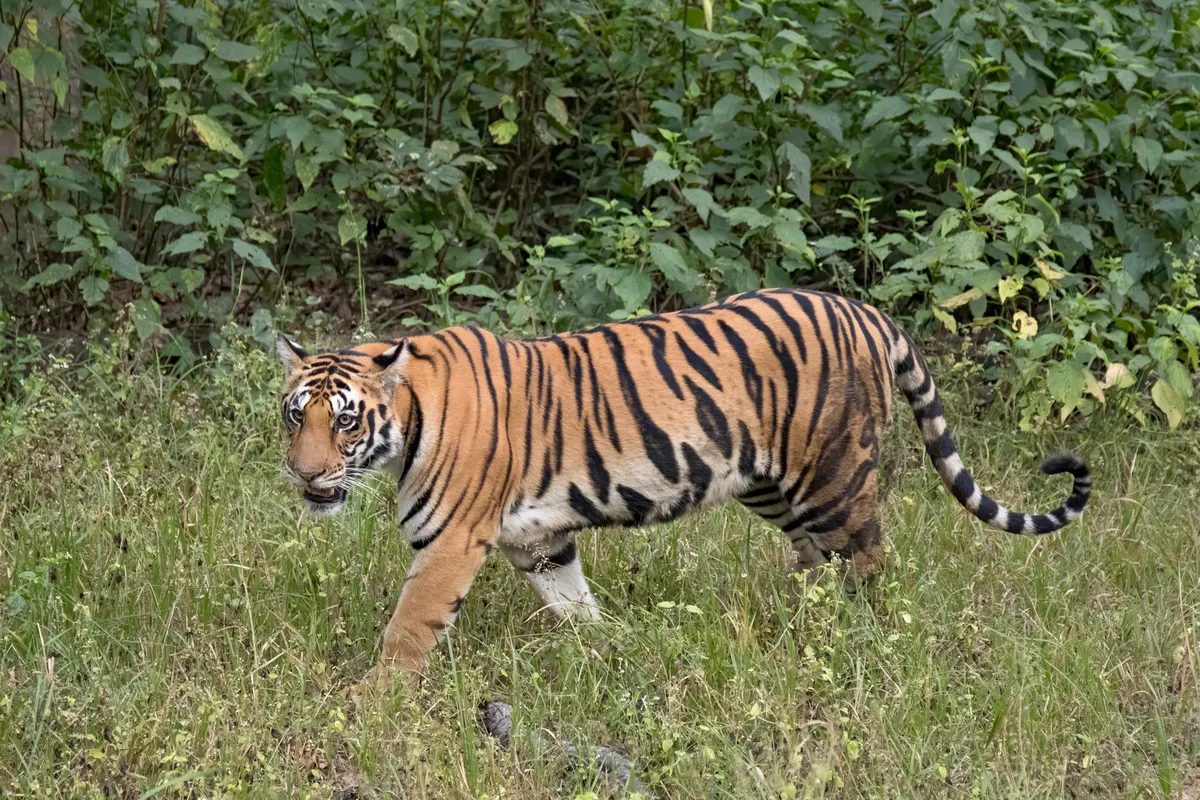
Adult male lions are recognised by the mane, though its colour and fullness vary and can darken with age. Tigers have dark vertical stripes that are unique to each animal, like a fingerprint. Lion cubs are born with spots that usually fade; tiger cubs are born with blue eyes.
Each coat matches its background. A lion's tawny colour works against dry grass and open woodland. Tiger stripes break up the body outline among stems, reeds, and forest shadow.
Both roar, at different ranges
A lion's roar carries up to about 5 miles on a quiet night; a tiger's carries roughly 2 miles. Both are used to advertise presence, but they serve different social systems — one coordinates and defends a group, the other maintains spacing between solitary animals.
The same ambush, minus the help
Both are obligate carnivores and both hunt by ambush: use cover, approach closely, accelerate over a short distance, seize the prey. The lion profile lists up to 50 mph in short bursts and the tiger up to 40 mph; neither is a distance runner.
Lions commonly hunt zebra, wildebeest, antelope, buffalo, and warthog. Tigers take deer, wild pig, buffalo, antelope, sambar, and gaur, with prey varying widely across Asia. The difference is social context: lionesses may spread around a herd and approach from more than one direction, while a tiger has to stalk, attack, and secure prey alone. A tiger can eat up to 88 pounds of meat in one meal after a kill.
Neither succeeds on every attempt. Hunting large prey is dangerous and expensive, both may scavenge when a carcass offers a safer meal, and both have to defend food from competitors.
Savanna against forest and mangrove
Most lions live in African savanna, grassland, and open woodland, with a small Asiatic population in India. Tigers live only in Asia and occupy a broader set of habitats: tropical and temperate forest, mangrove, and grassland across India, Nepal, Bangladesh, Bhutan, China, Russia, Indonesia, and Malaysia.
Open lion country favours long-distance visibility, group territory defence, and a coat that vanishes in dry vegetation. Tiger habitat usually supplies denser cover for a solitary stalk. Tigers also enter water readily and are strong swimmers, often resting in rivers to cool off; lions can swim but rarely need to.
Range size depends on prey density, water, cover, and pressure from neighbouring cats. A tiger in prey-poor habitat may need an enormous individual range, while a pride defends a shared territory whose boundaries shift with rainfall and herds.
Why this page does not pick a winner
A staged confrontation is not a scientific test of either species, and its outcome would depend on the individuals and the circumstances rather than on the species. There is no usable universal answer to which is "stronger": body size favours some tigers, while age, sex, health, and terrain can matter more than the label.
The defensible comparison is how each cat is built and how that build functions where it actually lives.
Vulnerable against Endangered
The lion is Vulnerable and the tiger Endangered in this dataset, both with decreasing populations. Habitat loss, declining prey, poaching, and conflict with people affect both, but the balance of those threats differs across ranges — and the tiger, the species with the wider habitat tolerance, carries the higher risk category.